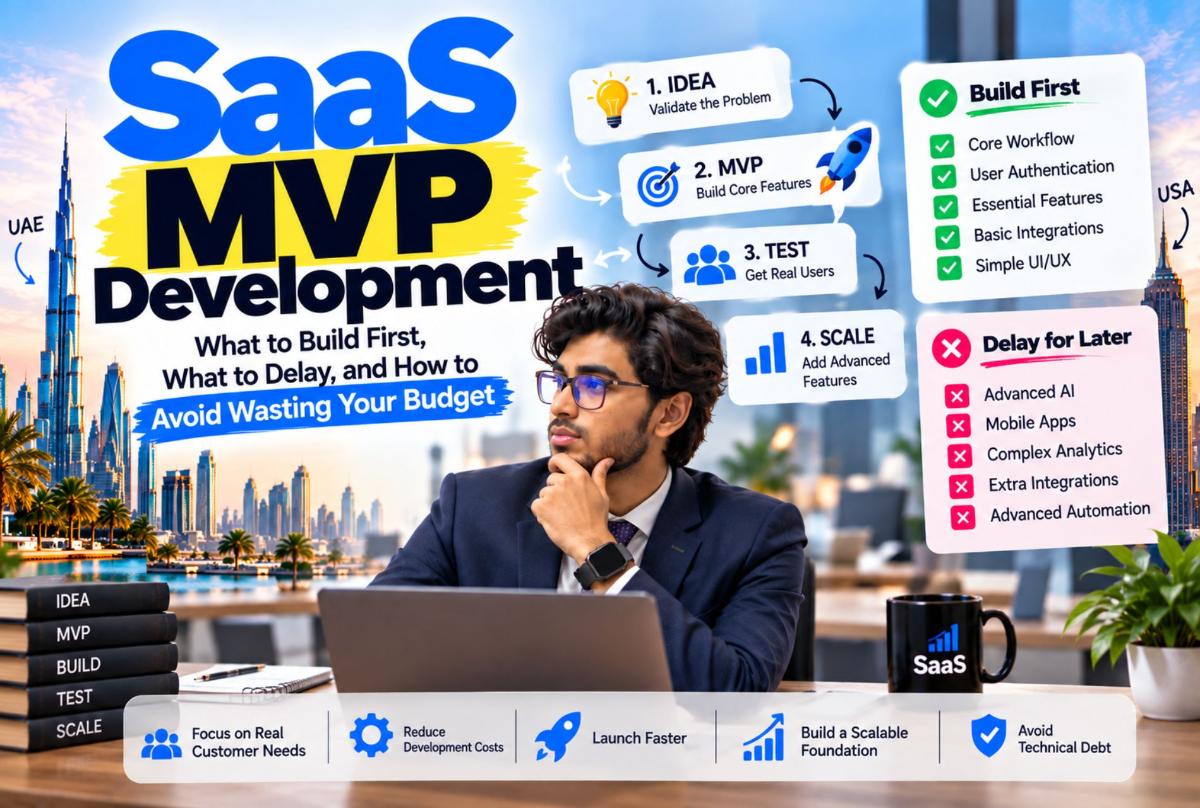
Building a SaaS product does not mean building every feature you have imagined.
That is one of the easiest ways to burn through a development budget before you know whether customers actually want the product.
A better SaaS MVP development strategy starts with one question: What is the smallest reliable product that can solve the core problem for the first group of customers?
That does not mean building a low-quality application. It means controlling the scope while keeping the underlying product architecture capable of evolving.
For founders and businesses in the United States and UAE, this distinction matters because a SaaS MVP may eventually become a much larger commercial platform. The first version should therefore be small enough to launch, but structured well enough to develop further.
This guide sits in the Founder & SaaS Product Engineering cluster with custom SaaS development cost, SaaS MVP development cost, how to choose a SaaS development company, SaaS product development process, SaaS development team structure, and custom SaaS vs off-the-shelf software.
What Is a SaaS MVP?
A SaaS MVP is the first usable version of a software product that contains enough functionality to test its core value proposition with real users.
It normally includes a defined target user, a specific problem, one or more core workflows, user authentication, the essential application logic, a usable interface, basic administration, necessary integrations, and deployment infrastructure.
It does not necessarily include every feature on the product roadmap.
For example, imagine a SaaS platform for cleaning companies. The long-term product might eventually include CRM, lead management, scheduling, staff management, GPS tracking, invoicing, payroll, inventory, customer portal, mobile applications, AI automation, and analytics.
That does not mean all of those capabilities belong in the MVP. The first release might focus on:
- Lead
- Quote
- Booking
- Job
- Completion
If that workflow is the reason customers would pay for the software, it should receive the majority of the initial development effort. Related: how to scope a software development project.
SaaS MVP Development Is About Prioritization
The difficult part of MVP software development is usually not identifying features. It is deciding what not to build.
Founders often have a roadmap that looks like this: “We need CRM, AI, mobile apps, dashboards, integrations, payments, automation, reporting and an admin portal.”
The problem is that every additional feature creates more than one development task. A feature may require UI, database changes, APIs, permissions, testing, notifications, error handling, documentation, and deployment considerations.
Ten features can therefore create dozens of connected development requirements. This is why feature prioritization should happen before development begins — and before you compare SaaS MVP development cost quotes.
Start With the Core Customer Problem
Before creating a feature list, write down:
- Target customer — Who will use the product?
- Current problem — What are they struggling with?
- Current solution — What do they use today?
- Core workflow — What should your product allow them to do more effectively?
- Business value — Why would they pay for it?
If those questions are unclear, adding more features will not solve the underlying problem. That is the practical start to how to build a SaaS MVP.
The Core Workflow Should Drive the MVP
A useful technique is to map the customer’s primary workflow. For example, a B2B service-management SaaS might work like this:
- Lead arrives
- Sales qualification
- Quote created
- Customer approves
- Service scheduled
- Employee assigned
- Job completed
- Invoice generated
- Customer receives update
That workflow gives you a much stronger foundation for MVP planning than a random list of features.
Instead of asking “What features should our SaaS have?” ask: What does the customer need to accomplish from beginning to end?
What Should Usually Be Included in a SaaS MVP?
There is no universal feature list, but many SaaS products require a basic foundation for SaaS application development.
Authentication
Users need a secure way to register, sign in, sign out, reset passwords, and manage accounts.
User and Organization Management
For B2B SaaS, this can include organization creation, team members, roles, permissions, and organization settings.
Core Business Workflow
This is the most important part. It is the functionality that actually solves the customer’s problem.
Basic Dashboard
The dashboard should show information users actually need to operate the product. Avoid building a dashboard simply because SaaS products are expected to have dashboards.
Basic Administration
Administrators may need to manage users, configure settings, review activity, and manage core records.
Essential Notifications
Only implement notifications that support the primary workflow.
Required Integrations
Integrate external systems only when they are necessary for the MVP to function or provide its core value. See SaaS product development.
What Should Usually Be Delayed?
Some features are useful but do not necessarily belong in version one. Examples include advanced AI, complex analytics, native mobile applications, large integration libraries, advanced workflow builders, custom report builders, white-label functionality, enterprise administration, and complex automation engines.
These can become later phases when there is evidence that customers need them.
AI Should Not Automatically Be Part of the MVP
AI is increasingly common in SaaS products. That does not mean every SaaS MVP needs multiple AI agents.
Consider two approaches. A weak approach adds an “AI assistant” because competitors have one. A stronger approach identifies a specific workflow where AI reduces manual work.
- Customer message
- AI classifies request
- System checks customer information
- AI generates suggested response
- Employee approves
- Response is sent
Now the AI has a defined job. That is much easier to evaluate than an undefined “AI-powered platform.” When AI is genuinely part of the product thesis, see Largify’s AI & ML services.
Do Not Build a Mobile App Just Because the Product Is SaaS
A SaaS product can start as a web application. If your target customers primarily use desktop computers during business operations, a responsive web application may be sufficient for the first release.
Mobile development becomes more important when the workflow requires field employees, push notifications, camera access, GPS, offline functionality, or frequent mobile usage.
For example, field-service software may eventually require a mobile application for technicians. That does not mean the customer-facing administration portal and technician mobile app need to be developed simultaneously. Related: mobile app development and cross-platform vs native mobile app cost.
SaaS MVP vs Full Product
The difference is easier to understand through an example. Imagine a clinic management SaaS.
Long-term product
Patient management, appointment booking, doctor scheduling, billing, inventory, insurance, reports, patient portal, mobile application, AI assistant, automated reminders, and multi-location management.
MVP
Clinic account, staff accounts, patient records, appointment scheduling, basic billing, and a basic dashboard.
The MVP tests whether the clinic actually wants the core system. The later roadmap expands the product based on actual requirements. Related industry context: healthcare & clinics.
A Practical SaaS MVP Feature Prioritization Framework
One simple way to organize features is to put them into four categories.
| Category | Meaning | Action |
|---|---|---|
| Core | Without this feature, the product cannot solve the primary problem | Build it |
| Important | The product can work without it, but it significantly improves the workflow | Consider for first release if effort is reasonable |
| Later | Useful functionality that can be added after initial validation | Do not let it delay launch |
| Experimental | Ideas that sound interesting but have not been validated | Keep on the roadmap |
This prevents every idea from becoming an immediate development requirement during custom SaaS development.
How to Control SaaS MVP Development Cost
The biggest opportunity to control SaaS MVP development cost is usually scope — not cheap development.
Hiring the cheapest developers can create additional costs through rework, bugs, poor architecture, unclear requirements, technical debt, and missed deadlines.
A better approach is to control what is actually being built. For a full cost-driver breakdown, see SaaS MVP cost and custom SaaS development cost.
1. Define One Primary User
Do not start by trying to serve enterprises, startups, freelancers, agencies, consumers, and government organizations all at once. Choose the first customer group. The narrower the initial use case, the easier it is to define the product.
2. Define One Primary Workflow
If your product solves ten unrelated problems, it becomes difficult to know whether customers actually value any of them. Start with the workflow that creates the strongest reason to use the product.
3. Avoid Building Every Integration
Suppose customers eventually want Stripe, PayPal, QuickBooks, Xero, Salesforce, HubSpot, Slack, Google Calendar, and Microsoft Outlook. You may not need all of them in version one. Start with the integration that the initial customer segment actually requires.
4. Avoid Building Custom Infrastructure Without a Reason
Not everything needs to be built from scratch. Established services can often handle authentication, payments, email, storage, and analytics. Your engineering budget should focus on what differentiates the product.
5. Define Acceptance Criteria
Every major feature should have a clear definition of completion.
For example, instead of “Build appointment booking,” define: customer selects service, customer selects staff member, available times are displayed, double booking is prevented, booking is stored, confirmation is generated, and staff can view the appointment.
Now the development team knows what the feature actually means. Related booking depth: custom booking software cost and online booking system for salons.
Technical Architecture Still Matters in an MVP
“MVP” should not mean “Ignore architecture.”
Some shortcuts are harmless. Others create problems later. For example, if you know the product will eventually be multi-tenant, the data model should be designed with that requirement in mind. If you know subscription billing will eventually exist, the system should not be structured in a way that makes customer plans impossible to manage.
The goal is simple implementation, sensible architecture — not temporary architecture that must be rebuilt after launch. Related: website vs web application architecture.
Avoiding Technical Debt During MVP Development
Technical debt becomes dangerous when shortcuts affect the product’s foundation. Examples include duplicated business logic, hard-coded permissions, poor database structure, no documentation, no testing around critical workflows, credentials embedded directly in code, and no clear deployment process.
A small MVP can still have clean engineering. It simply does not need every enterprise feature on day one.
SaaS MVP Development Process
A practical SaaS product development process can look like this:
- Discovery
- MVP scope
- UX/UI
- Architecture
- Development
- QA
- Deployment
- Feedback
- Iteration
- Discovery — Define customer, problem, product proposition, core workflow, and business model.
- MVP scope — Separate must-have, important, later, and experimental.
- UX/UI — Design the critical workflows before engineering them.
- Architecture — Define application structure, database, authentication, permissions, APIs, and infrastructure.
- Development — Build the agreed MVP scope.
- QA — Test the actual customer workflows.
- Deployment — Release the MVP to a controlled group of users.
- Feedback — Observe how customers actually use it.
- Iteration — Prioritize the next features based on evidence.
For the full implementation path after MVP, see SaaS product development process.
What Happens After the MVP?
Launching the MVP is not the finish line. It creates a new source of information.
You can learn which features customers use, which workflows create friction, which features are ignored, which requests appear repeatedly, where users abandon the process, and what customers are willing to pay for.
That information should influence version two. Your roadmap should evolve.
SaaS MVP Development for US Businesses
For US-focused SaaS products — including teams evaluating a SaaS MVP development company USA or SaaS development company USA — founders often need to think beyond the initial application.
The product may eventually need subscription management, business integrations, customer onboarding, analytics, team permissions, enterprise capabilities, security controls, and support workflows.
The important point is not to build all of these immediately. Build the foundation around the customer problem and keep the architecture capable of evolving. See the United States market page and custom B2B software for UAE and USA.
SaaS MVP Development for UAE Businesses
For UAE businesses evaluating a SaaS MVP development company UAE or SaaS product development company Dubai, MVP requirements can vary considerably by industry.
A multi-branch business may need branch management, staff permissions, customer records, local workflows, Arabic and English interfaces where required, payment integrations, and reporting. A startup building SaaS for UAE customers may have completely different requirements.
The market does not determine the entire MVP. The target customer and workflow do. See the UAE market page and multi-branch management systems.
ValionOS: An Example of Product Evolution
ValionOS illustrates why SaaS products often need to evolve in stages.
The broader concept is a business operating system covering CRM, bookings, projects, inventory, finance, HR, reporting, automation, and AI capabilities.
Building every capability at the same time would create a very large initial scope. A product like this is better understood as an evolving platform where individual business workflows can be developed, validated, and expanded over time.
For businesses considering whether fragmented software tools should eventually be replaced with a more unified operating system, explore ValionOS or read the ValionOS case study.
How to Know Your MVP Is Too Large
Your MVP may be too large if:
- The feature list keeps growing
- Every department wants its own module
- You cannot explain the product in one sentence
- Development milestones are difficult to define
- You need many integrations before launch
- Mobile and web versions are both required immediately
- You have multiple unrelated customer segments
- You are building advanced analytics before customers use the core workflow
- Nobody can identify which feature proves the business model
The hardest MVP decision is often removing something you want. That is exactly why the decision needs to be made before development begins.
How to Know Your MVP Is Too Small
Going too far in the opposite direction also creates problems.
An MVP is not a clickable prototype, a collection of static screens, a landing page pretending to be software, or a broken application with half the core workflow missing.
The user should be able to complete the primary task. If a customer cannot experience the actual value proposition, you are testing the wrong thing.
What to Ask a SaaS MVP Development Company
Before hiring a SaaS MVP development company or deciding to hire SaaS developers, ask:
- How will you define our MVP?
- Which features would you recommend delaying?
- How will the architecture support future development?
- How will multi-tenancy be handled?
- How will permissions work?
- What integrations are essential for version one?
- What testing is included?
- How are milestones defined?
- Who owns the source code?
- Who owns the infrastructure accounts?
- How are scope changes handled?
- What happens after launch?
- How will technical documentation be delivered?
- Can another team take over the project?
- What assumptions are included in the estimate?
The answers tell you much more than a generic portfolio presentation. Pair this list with how to choose a SaaS development company and the software company evaluation checklist.
When Should You Hire a SaaS Development Company?
A specialized SaaS product development company can be useful when your product requires several connected capabilities: product planning, UX/UI, frontend engineering, backend engineering, database architecture, API development, QA, DevOps, and AI integration.
For a complex commercial SaaS product, coordination between these areas becomes part of the engineering problem. Related: agency vs product engineering firm and SaaS development team structure.
Largify provides custom SaaS development services for businesses that need software built around specific workflows rather than simply adopting an existing generic tool.
The Goal of an MVP Is Not to Look Small
A good MVP can be technically sophisticated while remaining narrow in scope.
Think of it like opening a restaurant. You do not need 300 dishes to prove people want your food. You need a focused menu, consistent quality, a working kitchen, a reliable ordering process, and real customers. Once you understand what customers actually order, you expand the menu.
SaaS works similarly. Build the core experience properly. Then expand based on evidence.
How Largify Approaches SaaS MVP Development
Largify’s SaaS MVP development services focus on discovery before feature lists expand — so the first release tests the business proposition without locking you into rebuilds.
- Define the problem
- Identify the core customer
- Map the primary workflow
- Prioritize MVP features
- Design the architecture
- Build the first usable product
- Test with real users
- Use evidence for version two
If you are planning a SaaS product and need help turning the idea into a defined MVP, explore Largify’s SaaS product development services or discuss the product requirements.
Final Takeaway
SaaS MVP development should not be treated as “building the cheapest possible version.” It is about building the smallest useful version.
The distinction matters. A cheap product may save money during development and create expensive problems afterward. A focused MVP gives you a better way to test the customer problem, the core workflow, product usability, willingness to pay, technical assumptions, and future product requirements.
For US and UAE businesses planning a new SaaS product, the practical sequence is: define the problem, identify the core customer, map the primary workflow, prioritize MVP features, design the architecture, build the first usable product, test with real users, and use the evidence to build version two.
Frequently Asked Questions
What is SaaS MVP development?
SaaS MVP development is the process of building the first usable version of a software-as-a-service product with enough functionality to test its core business proposition with real users.
How much does SaaS MVP development cost?
There is no universal cost. The budget depends on product scope, architecture, integrations, user roles, design requirements, security, mobile requirements, and development team structure. See SaaS MVP development cost.
What should be included in a SaaS MVP?
The MVP should include the functionality required for customers to complete the product’s primary workflow. Authentication, user management, core business logic, and essential administration are common components.
Should AI be included in a SaaS MVP?
Only when AI directly contributes to the core product value. AI should not be added simply because it is commercially popular.
Should a SaaS MVP have a mobile app?
Not necessarily. A responsive web application can sometimes be sufficient for the first release. Mobile development becomes more important when the product depends on mobile-specific workflows.
How long does SaaS MVP development take?
The timeline depends on the scope and complexity of the MVP. A focused product with one core workflow can require substantially less work than a multi-tenant platform with multiple integrations and user roles.
Should I hire a SaaS MVP development company?
For products requiring coordinated product, design, engineering, QA, and infrastructure work, a specialized SaaS development company can provide a unified development process. Start with how to choose a SaaS development company.
Explore SaaS product development · build your product · how to choose a SaaS development company · SaaS MVP cost · custom SaaS cost · development process · team structure · custom SaaS vs off-the-shelf · ValionOS.