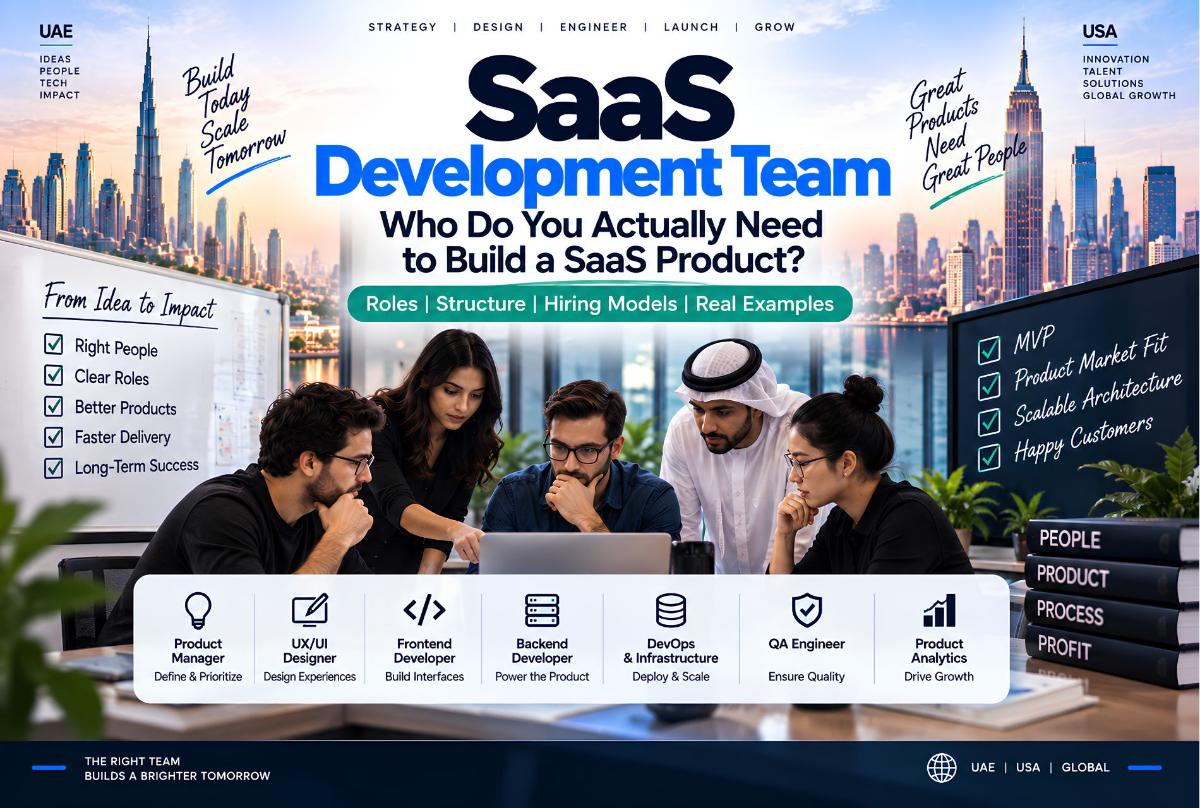
A SaaS product is not built by a single developer writing code from a feature list.
Even a relatively focused SaaS MVP involves decisions about product scope, user experience, architecture, databases, authentication, business logic, testing, deployment and ongoing iteration.
The real question is not “How many developers do I need?” It is: What capabilities does the product require, and who should own each one?
For a founder in the United States or UAE, this distinction matters when deciding whether to hire freelancers, build an internal team, work with a dedicated SaaS development team, or use a SaaS product development company.
This guide complements what to build first in a SaaS MVP, SaaS MVP cost, custom SaaS development cost, SaaS product development process, and agency vs product engineering firm — then points to Largify’s SaaS product development services.
What Does a SaaS Development Team Do?
A SaaS development team turns a product idea into software that customers can actually use. A typical process looks like:
- Problem
- Product definition
- UX
- Architecture
- Development
- Testing
- Deployment
- Feedback
- Iteration
Each stage creates different responsibilities. A developer can handle some of these, but expecting one person to own every discipline creates unnecessary risk as the product becomes more complex.
Largify approaches SaaS as product engineering rather than isolated feature implementation — covering MVP engineering, multi-tenant architecture, billing, analytics, infrastructure and integrations through SaaS product development.
The Core Roles in a SaaS Development Team
A SaaS team does not necessarily require one full-time employee for every role. Some roles can be combined in a small startup. Others become specialized as the product grows.
The core capabilities are:
- Product ownership
- Product management
- UX/UI design
- Frontend engineering
- Backend engineering
- Database and architecture
- Quality assurance
- DevOps and infrastructure
- Security
- Product analytics
1. Product Owner or Founder
The founder does not need to know how to write the backend. They do need to own the product decisions.
The founder should understand who the customer is, what problem the product solves, why the problem matters, what customers currently use, what the MVP needs to prove, which features matter most, and what should not be built yet.
This responsibility should not be outsourced completely. A development team can challenge assumptions and provide technical guidance, but the business owner ultimately decides what the product is supposed to achieve. Related reading for non-technical founders: how to build a SaaS without a technical cofounder.
2. Product Manager
A product manager translates business objectives into an executable product roadmap. Responsibilities can include requirements, user stories, feature prioritization, product roadmap, acceptance criteria, sprint planning, stakeholder communication, customer feedback and release planning.
In an early startup, the founder may perform this role. As the product grows, a dedicated product manager can become valuable.
The important distinction is that product management is not project management. A project manager asks whether delivery is on time. A product manager also asks whether the team should be building the feature at all.
3. UX/UI Designer
A SaaS product can technically work and still be difficult to use. The UX designer focuses on how users move through the product — user journeys, information architecture, wireframes, navigation, forms, onboarding, interaction patterns, error states and responsive behavior.
The UI designer focuses more heavily on the visual system: typography, components, spacing, colors, visual hierarchy and design systems.
For a simple MVP, one product designer may handle both. For a complex SaaS platform, UX and UI can become separate specialties. Explore Largify’s UI/UX and product design services for journey mapping, wireframing, design systems and usability testing.
4. Frontend Developer
The frontend developer turns product designs into the interface customers actually interact with — web applications, dashboards, customer portals, admin interfaces, forms, tables, charts, responsive layouts, API integration and state management.
For a SaaS application, frontend development is more than making screens look correct. The frontend must correctly handle loading states, empty states, validation, permissions, errors, network failures and different user roles.
A dashboard that looks good in a design file is not necessarily a functional SaaS interface. Related web delivery context: web development.
5. Backend Developer
The backend is where much of the product’s business logic lives. A backend engineer may be responsible for APIs, authentication, authorization, database operations, business rules, payments, notifications, integrations, background jobs, data validation and audit trails.
Consider a simple booking action. The frontend might show “Book Appointment.” The backend needs to determine:
- Authenticate user
- Check service availability
- Check staff availability
- Prevent double booking
- Apply permissions
- Process payment if required
- Send notification
- Update reports
That is backend engineering — and a major reason SaaS developers are usually not interchangeable with “website builders.”
6. Software Architect or Senior Full-Stack Engineer
Not every startup needs a separate architect. But somebody needs to own the architecture.
That person should make decisions around application structure, database design, API boundaries, authentication, authorization, multi-tenancy, integrations, scalability, infrastructure and technical debt.
This role becomes particularly important when building a commercial SaaS platform. Largify’s SaaS work covers multi-tenant architecture, including shared-database and database-per-tenant approaches and PostgreSQL Row Level Security — see SaaS product development.
7. QA Engineer
Quality assurance should not mean clicking around the application once before launch. A QA engineer tests whether the product behaves correctly under expected and unexpected conditions.
- Normal case — Customer books an available appointment.
- Edge case — Two customers attempt to book the same time.
- Failure case — Payment succeeds but the browser closes before confirmation.
- Permission case — An employee attempts to access an administrator function.
- Integration case — A third-party API becomes unavailable.
These situations matter because SaaS products operate continuously with real users.
8. DevOps and Infrastructure
Someone needs to own how the application gets from development to production: cloud infrastructure, CI/CD, deployment, environment management, secrets, monitoring, backups, logging, scaling and incident response.
For an early SaaS MVP, a senior engineer may handle these responsibilities. As infrastructure becomes more complicated, dedicated DevOps or platform engineering becomes more useful. See Cloud & DevOps for deployment and scaling capability.
9. Security Ownership
Security is not a role you can simply add at the end of the project. Someone needs to own authentication, authorization, data access, secrets, API security, input validation, dependency updates, backups, logging and tenant isolation.
This becomes especially important when SaaS applications handle customer information, payments, business records or sensitive operational data.
For multi-tenant SaaS, the question is not simply “Can users log in?” It is: Can one organization ever access information belonging to another organization? That needs to be addressed at the architecture level. Related: cybersecurity.
10. Product Analytics
Once users start using the product, you need to understand what is happening — signups, activation, feature usage, trial conversion, subscription activity, churn, retention and workflow completion.
The exact metrics depend on the business model. Do not install analytics simply because every SaaS product has analytics. Track the events that help you make product decisions.
How Many People Do You Actually Need?
This is where founders often overbuild the team. You do not necessarily need ten people to launch a SaaS MVP.
A focused early-stage product could potentially be handled by a compact SaaS MVP development team covering:
- Product — Founder or product owner
- Design — Product designer
- Engineering — Senior full-stack engineer plus additional frontend/backend capacity where required
- Quality — QA capability
- Infrastructure — Senior engineer or DevOps capability
The exact structure depends on the product. A simple SaaS product can combine several responsibilities. A complex platform should not assume that one person can safely own everything. For cost implications of scope, see SaaS MVP cost.
Example: Small SaaS MVP Team
Suppose you are building a web SaaS with one core workflow, a basic dashboard, authentication, simple subscriptions and one or two integrations. A practical team could look like:
- Founder / Product Owner — Owns product decisions
- Product Designer — Owns UX/UI
- Senior Full-Stack Engineer — Owns core architecture and development
- Additional Engineer — Adds capacity where required
- QA — Tests releases and critical workflows
- DevOps capability — Handles deployment and infrastructure
Some of these responsibilities can be combined.
Example: Larger SaaS Platform Team
Now imagine the product includes multiple organizations, complex permissions, subscription billing, AI, mobile apps, multiple integrations, advanced analytics, real-time functionality and large operational workflows.
The SaaS product development team might need a product manager, product designer, UX specialist, frontend engineers, backend engineers, QA engineers, DevOps/platform engineer, security expertise, data/analytics expertise and AI/ML engineering.
The point is not to hire all of these people immediately. The point is to recognize that the product’s complexity creates additional ownership requirements. When AI is part of the product thesis, see AI automation and integration.
In-House Team vs SaaS Development Company
There are several ways to build the team.
Option 1: Internal Team
You hire employees directly.
Advantages: high internal control, long-term institutional knowledge, direct collaboration, easier alignment with company culture.
Challenges: recruitment, management, hiring speed, employee costs, retention, and building multiple technical disciplines.
This model can make sense when software development is central to the company’s long-term operation.
Option 2: Freelancers
You assemble individual specialists — for example one designer, one frontend developer, one backend developer and one QA freelancer.
Advantages: flexible, potentially lower initial commitment, easy to add specific expertise.
Challenges: coordination, accountability, architecture ownership, availability, knowledge fragmentation and long-term continuity.
The problem is not that freelancers cannot build good software. The problem is that someone still has to own the whole system.
Option 3: Dedicated SaaS Development Team
A dedicated SaaS development team gives the business access to several technical capabilities through one delivery structure — product engineering, UX/UI, frontend, backend, QA and DevOps.
The main benefit is coordination. Instead of asking who is responsible for connecting five disconnected pieces, the team has defined ownership across the product.
Option 4: Product Engineering Company
A product engineering company can be useful when you need more than development capacity. The engagement may include product discovery, architecture, UX, MVP development, QA, deployment and iteration.
That model is particularly relevant when the founder has a product vision but does not already have an internal technical organization. Largify positions its work as this broader product engineering model — compare delivery styles in agency vs dedicated product engineering firm.
The Cheapest Team Is Not Always the Lowest-Cost Team
Consider two hypothetical teams.
Team A has a lower hourly rate, but weak documentation, no clear architecture owner, limited QA, a founder managing every technical decision, and different freelancers handling different parts.
Team B has a higher initial cost, but clear architecture, defined ownership, structured development, QA, documentation, controlled deployment and a consistent team.
Team A may look cheaper on a spreadsheet. The actual cost depends on what happens during and after development. This is why evaluating a SaaS development company should include ownership, delivery process and architecture — not just developer rates. Use the vendor evaluation checklist alongside scope discipline from how to scope a software development project.
What Should the Founder Own?
You should generally retain ownership of the customer, the problem, the business model, product direction, priorities and customer feedback.
You do not need to personally own database architecture, API implementation, CI/CD, infrastructure configuration, frontend implementation or backend implementation — unless you have the technical expertise and want to.
What Should the Technical Team Own?
The technical team should be accountable for architecture, implementation, code quality, testing, technical documentation, deployment, technical security practices, infrastructure and technical maintenance.
There should be a clear boundary between product decisions and technical implementation decisions. The founder should not need to dictate every database table. The technical team should not independently decide what business problem the company should solve.
A SaaS Development Team Needs One Technical Owner
One of the easiest ways to create confusion is having five developers and nobody responsible for the architecture.
You end up with Developer A building one approach, Developer B building another, and Developer C introducing a third pattern. Six months later, the application has three ways of solving the same problem.
Someone needs to own technical consistency — a CTO, technical cofounder, lead engineer, software architect, engineering lead or product engineering partner. The title matters less than the responsibility.
SaaS Development Team Structure for a Startup
A practical SaaS development team structure can look like this:
- Founder / CEO
- Product owner
- Product design
- Engineering lead
- Frontend / Backend / QA / DevOps
In a small startup, several boxes can be the same person. As the company grows, responsibilities become specialized.
How Team Structure Changes From MVP to Scale
Your team should evolve with the product.
- Idea
- MVP
- Early customers
- Expansion
Stage 1: Idea
Focus on validation, product definition, prototype and technical feasibility. You do not need a large engineering organization.
Stage 2: MVP
Focus on core workflow, architecture, UX, development, QA and launch.
Stage 3: Early Customers
Add capacity around customer feedback, reliability, analytics, integrations and support.
Stage 4: Product-Market Expansion
You may need multiple engineering squads, product management, dedicated QA, platform engineering, security, data and customer success.
The mistake is building Stage 4 before the business has reached Stage 2.
How ValionOS Illustrates Product Team Complexity
ValionOS provides a practical example of a SaaS product that goes beyond a single workflow.
Largify describes ValionOS as a live, multi-industry, multi-tenant SaaS platform combining business applications, automation and an AI layer. Its architecture includes organizations, users, roles, shared business capabilities, industry modules and AI-assisted workflows.
That type of platform requires different technical concerns from a simple MVP — multi-tenancy, permissions, modular applications, shared business data, automation, AI, integrations and continuous product evolution.
This is exactly why SaaS development is a team problem rather than simply a coding problem.
Read the ValionOS product engineering case study.
Avoeline Shows Why Product Scope Changes Team Requirements
Avoeline is another Largify proprietary SaaS product. Its case study describes an EventTech product spanning web and mobile, with an MVP focused on event creation, registration, check-in, certificates, payments, analytics and vendor profiles. Future phases include additional capabilities such as marketplace functionality, collaboration and AI planning.
The distinction between MVP and later phases is important. If all of those capabilities were required simultaneously, the SaaS engineering team would need significantly broader expertise. By separating phases, the team can focus initial engineering capacity on the product’s core lifecycle.
Read the Avoeline SaaS case study.
What to Ask a SaaS Development Company
Before you hire SaaS developers or engage a partner, ask:
Product
- Who will help define the MVP?
- Who owns product requirements?
- How do you handle changing requirements?
Architecture
- Who is responsible for architecture?
- How will multi-tenancy work?
- How will permissions be handled?
- How will integrations be structured?
Engineering
- Who writes the code?
- Who reviews it?
- Who handles technical documentation?
Quality
- Who tests the product?
- How are critical workflows tested?
- What happens when something breaks after launch?
Ownership
- Who owns the source code?
- Who controls the repository?
- Who controls cloud infrastructure?
- Who owns third-party service accounts?
After Launch
- Who maintains the product?
- How are future features handled?
- Can the same team support later versions?
These questions reveal much more than a list of technologies.
SaaS Development Team Cost Depends on Structure
The cost of a SaaS development team depends on number of people, seniority, location, engagement model, product complexity, development timeline, required specialties and infrastructure requirements.
A founder hiring one senior full-stack developer is making a fundamentally different investment from a founder hiring a complete product engineering team. That is why SaaS development pricing should be evaluated against required capabilities rather than simply a developer’s hourly rate — see SaaS MVP cost.
For US Founders: Offshore and Distributed Teams
US startups sometimes use distributed engineering teams to access development capacity without building the entire technical organization locally.
Largify’s US offering positions MVP development, distributed engineering economics, IP protection, US-friendly commercial terms and timezone overlap — see the United States market page.
For a US founder considering this model, the important questions remain: Who owns the IP? Who controls the source code? Who is responsible for architecture? What timezone overlap exists? How are milestones handled? How is communication managed?
Location alone does not determine whether a development relationship will work. Operating structure matters. That is why “SaaS development company USA” searches should evaluate delivery model, not just geography labels.
For UAE Companies: Choosing a SaaS Development Team
UAE businesses building SaaS products often need a team capable of working across commercial and technical requirements — B2B software, multi-tenant SaaS, subscription models, business workflows, Arabic and English product requirements where applicable, regional integrations, cloud deployment and long-term product support.
The same principle applies: do not hire based only on the number of developers. Hire based on the capabilities required by the product. See the UAE market page and Largify’s broader markets footprint when evaluating a SaaS development company UAE.
The Team You Need Depends on the Product You Are Building
A CRM MVP does not need the same team as a fintech SaaS, healthcare platform, marketplace, AI application, ERP, EventTech platform or multi-branch business operating system.
The product determines the technical constraints. The technical constraints determine the team — not the other way around.
A Practical SaaS Team Planning Checklist
Before hiring anyone, define:
Product
- Target customer
- Core problem
- Core workflow
- MVP scope
Users
- User types
- Roles
- Permissions
Technology
- Web
- Mobile
- Backend
- Database
- APIs
- Integrations
Complexity
- Multi-tenancy
- Billing
- AI
- Real-time functionality
- Analytics
- Security
Delivery
- Product design
- Development
- QA
- Deployment
- Maintenance
Ownership
- Source code
- Repository
- Cloud accounts
- Domains
- Third-party services
- Documentation
- IP
Once these are defined, you can determine what your team actually needs.
Final Takeaway
You do not need a huge SaaS development team just because you have a big product vision. You need the right capabilities at the right stage.
For an early SaaS product, that usually means covering product → design → architecture → frontend → backend → QA → infrastructure.
The responsibilities can be combined when the product is small. They should become specialized when the product becomes complex.
The critical mistake is not having a small team. The critical mistake is having no clear owner for product decisions or technical architecture.
If you are building a SaaS product for the United States or UAE, define the MVP first, identify the technical capabilities it requires, and then choose the team structure. Do not hire ten people because the roadmap contains ten departments. Build the team around the product you actually need to launch.
Explore Largify’s SaaS product development services · what to build first · SaaS MVP cost · custom SaaS development cost · development process · custom SaaS vs off-the-shelf · ValionOS · Avoeline · start a discovery discussion.
Frequently Asked Questions
How many developers do I need to build a SaaS MVP?
There is no universal number. A focused MVP can be built with a compact team covering product, design, engineering and QA. More complex products require additional specialization.
What roles are needed for SaaS development?
Typical capabilities include product management, UX/UI design, frontend engineering, backend engineering, architecture, QA and DevOps. Security and analytics may become dedicated responsibilities as the product grows.
Can one developer build a SaaS MVP?
A skilled full-stack developer can build a focused SaaS MVP, particularly when the scope is narrow. The challenge is that product design, QA, security, infrastructure and architecture still need ownership.
Should I hire a SaaS development company or build an internal team?
The decision depends on your stage, budget, internal expertise and long-term software strategy. An internal team provides direct organizational ownership, while a development partner can provide multiple capabilities without requiring you to recruit an entire engineering organization.
What is a dedicated SaaS development team?
A dedicated SaaS development team is a group of professionals assigned to build and evolve a SaaS product, typically covering engineering and related product capabilities under a coordinated delivery structure.
What should I ask a SaaS development company before hiring them?
Ask about MVP scope, architecture, technical ownership, source-code ownership, IP, QA, deployment, milestones, communication, maintenance and what happens when the product enters its next development phase.