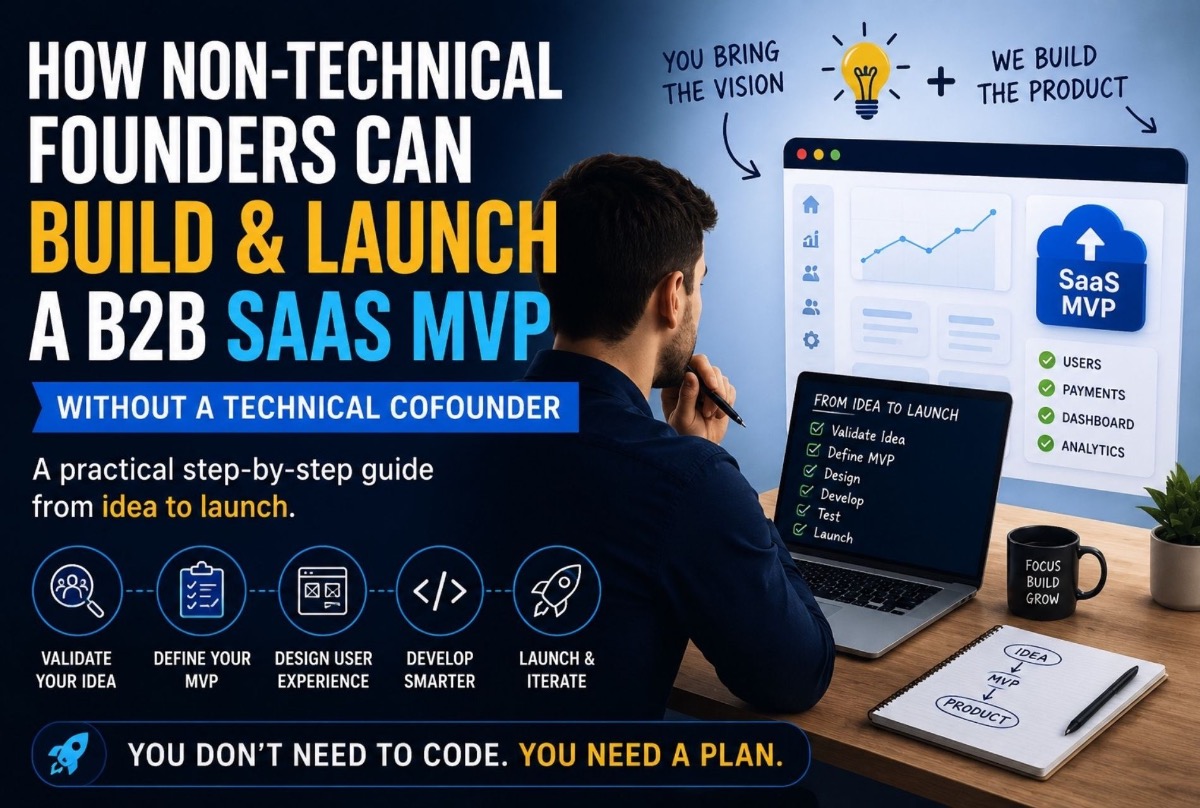
You have the SaaS idea.
You understand the problem you want to solve. You may already know your target customer, pricing model, or even what the product should look like.
The problem is simple:
You are not technical, and you do not have a technical cofounder.
That does not mean you cannot build the product. It does mean you need to approach the project differently.
The biggest mistake non-technical founders make is thinking they need to become software engineers before they can build a SaaS product. You do not.
You need to understand the product well enough to make decisions, communicate requirements clearly, validate assumptions, and work with people who can handle the technical execution.
This guide explains how to build a SaaS without a technical cofounder, what you should handle yourself, what should be outsourced, and how to avoid wasting money before you have a product worth scaling.
Can you build a SaaS without a technical cofounder?
Yes. A technical cofounder is useful, but it is not a mandatory requirement for launching a SaaS product.
A non-technical founder can own:
- The problem being solved
- Customer research
- Product positioning
- Business model and pricing
- Sales and customer relationships
- Product priorities
- Market validation
Technical specialists can handle:
- Architecture and infrastructure
- Backend and frontend development
- Database design
- Security implementation
- Integrations, testing and deployment
The important part is clear ownership. If you are the founder, you should not hand someone a vague idea and expect them to turn it into a successful product. Define the business problem first.
Start with the problem, not the features
A SaaS product should solve a specific problem for a specific customer.
“I want to build an AI platform for businesses.”
That is not yet a product specification. It is a category.
A better starting point:
“Small service businesses lose time responding to repetitive customer enquiries, managing bookings, and following up with leads.”
Now you have a problem that can be investigated. Ask:
- Who experiences this problem?
- How do they solve it today?
- What does the current process cost them?
- How frequently does the problem occur?
- What software are they currently using?
- What do they dislike about existing solutions?
- Would they pay for a better solution?
This research should happen before serious development begins.
Define your first customer
A common SaaS mistake is trying to build for everyone. “Businesses” is not a useful initial customer profile.
Weak target: businesses that need automation.
Stronger target: small and mid-sized service businesses that manage appointments, staff, customers and payments across multiple locations.
The second description gives you something concrete to build for — and makes interviews, product decisions, marketing and sales easier.
What should your MVP actually contain?
Your MVP is not the smallest version of every feature you can imagine. It is the smallest useful product that can test whether your core assumption is correct.
A long-term service-business platform might eventually include CRM, scheduling, invoicing, inventory, analytics, mobile apps, AI assistants, marketing automation, staff management, customer portals and integrations. When the mobile layer becomes part of the MVP or near-term roadmap, compare cross-platform vs native mobile app development cost before you commit to separate iOS and Android builds.
Trying to build all of that before customer feedback is a good way to spend months building something nobody wants.
Your MVP might instead focus on customer management + booking + one core operational workflow.
The principle is simple: build the smallest product that can prove the biggest assumption.
Create a product requirements document
You do not need to write code to give developers useful requirements. You do need to describe what the product should actually do.
Users
Who will use the product? For example: business owner, manager, employee, customer.
Core workflows
What should each user accomplish? Example:
Customer → Creates account → Selects service → Chooses time → Confirms booking
Features and rules
What functionality is required for each workflow? What happens when something goes wrong — unavailable slots, cancellations, payment failures, manager overrides?
Permissions
Which users can see or change particular information?
This level of detail gives a development team something concrete to work from.
You do not need to choose the technology yourself
Non-technical founders can lose weeks comparing languages, databases, frameworks, hosting and AI models.
Unless you can evaluate those decisions properly, define the product requirements and ask an experienced technical team to recommend the architecture. Your job is to ask:
- Why this architecture?
- What are the major technical risks?
- How will the system scale if usage increases?
- How will customer data be isolated?
- How will backups work?
- What happens if a third-party service goes down?
- What part of the system is most expensive to change later?
You do not need every technical answer. You need to understand the consequences of the answers.
Decide how you will build the product
Find a technical cofounder
This can work extremely well when the relationship is genuinely strong. The challenge is finding someone who combines technical ability with the same commitment to the business. A technical cofounder is not simply a free developer — you are bringing another founder into the company.
Hire freelancers
Useful for focused tasks: UI implementation, a specific integration, a landing page, a small feature. Risk increases when you need a complete SaaS product and end up managing several contributors without anyone owning the full system.
Hire an internal development team
More direct control — and responsibility for recruiting, salaries, technical leadership, process, infrastructure and quality. For a founder who has not validated the product, a full internal engineering organization can be premature.
Work with a SaaS development partner
A specialized partner can provide the technical team while you remain product owner. Do not outsource the entire product and disappear. You own the problem and priorities; the partner owns technical execution.
| Build path | Best when | Main risk |
|---|---|---|
| Technical cofounder | Shared commitment and complementary skills | Ownership and decision conflicts |
| Freelancers | Narrow, well-defined tasks | Fragmented ownership of the system |
| Internal team | Validated product and ongoing roadmap | High fixed cost before product-market fit |
| Development partner | You own product; need execution capacity | Weak partner process or unclear IP ownership |
How to choose a SaaS development partner
Do not choose a company only because the website looks impressive or because it promises speed. Ask about process.
Can they help with product scope?
A good team questions feature lists: Why does this exist? Who uses it? What happens before and after? What is the minimum version required? If every feature is accepted without challenge, you may pay for unnecessary work.
Do they understand SaaS architecture?
A SaaS product is different from a basic website. Architecture may need multiple customers, accounts, permissions, billing, data isolation, admin tooling, scaling, monitoring and updates.
Can they explain decisions clearly?
You should be able to ask “Why are we doing this?” and receive an answer tied to product, budget, security, scalability or future change — not a lecture of jargon.
If you want a partner focused on commercial multi-customer products, explore Largify’s SaaS product development services.
Build the MVP in stages
A SaaS project is easier to control when divided into stages:
- Discovery — customer, problem, MVP scope, workflows, risks
- Product design — flows, wireframes, interface structure
- Architecture — app structure, data model, auth, APIs, infrastructure
- MVP development — smallest version that supports validated workflows
- Testing — workflows, permissions, edge cases, integrations, security-sensitive areas
- Launch — deploy, onboard early users, monitor real usage
- Iterate — let behavior and feedback decide what comes next
This is safer than planning the entire product for a year and only then discovering customers wanted something different.
Do not confuse an MVP with a bad product
An MVP should be limited in scope. It should not be careless.
There is a difference between small and unfinished. You can launch with five important features instead of fifty — and those five should still work properly. Authentication, data handling and critical workflows should be tested. Reducing scope is sensible. Ignoring quality is not.
Validate before scaling
Your first users are a source of product information. Watch:
- Where they get confused
- Which features they ignore
- Which workflow takes too long
- Which feature they repeatedly request
- Which part they replace with spreadsheets
- Where they stop using the product
Customers may tell you one thing. Behavior may tell you another. Both matter.
What a non-technical founder needs to understand
You do not need to become a developer. You should understand concepts that affect business decisions:
- Frontend — what users interact with
- Backend — business logic and processing
- Database — where data is stored and organized
- API — how systems exchange information
- Authentication / authorization — who you are and what you can access
- Infrastructure — what runs the application
You do not need to write the code. You need enough understanding for productive conversations with the people who do.
How much should you spend on an MVP?
There is no universal SaaS MVP price. A simple product with few workflows needs very different resources from a platform with complex permissions, payments, integrations, AI or real-time features.
The wrong approach: “I have a fixed budget — what SaaS can you build?”
The better approach: “Here is the problem, customer and smallest workflow to validate. What is the simplest reliable architecture for that?”
Then scope and budget can be discussed realistically — without inventing a one-size price.
What happens after the MVP?
Launching is the beginning of product learning. Real usage helps answer:
- Which feature is used most?
- Where do users abandon a workflow?
- Which customers retain the longest?
- What causes support requests?
- What should be automated, built next — or removed?
The roadmap should evolve from evidence rather than assumptions.
A useful founder and development team split
| Area | Founder | Development team |
|---|---|---|
| Customer research | Own | Support |
| Product vision | Own | Advise |
| Business model | Own | Advise |
| Feature priorities | Own | Advise |
| UX requirements | Own | Collaborate |
| Architecture | Review | Own |
| Development | Review | Own |
| Testing | Participate | Own |
| Deployment | Review | Own |
| Customer feedback | Own | Support |
| Technical maintenance | Review | Own |
This keeps the founder involved without requiring them to become the technical lead.
What can go wrong?
The biggest risks usually come from unclear decisions — not from a lack of coding knowledge.
- Building too many features — a long list can hide uncertainty
- Starting before validation — if the problem is not painful enough to pay for, development is speculation
- Choosing only on price — a lower rate can mean higher long-term cost if architecture is weak
- Giving an idea instead of requirements — “like Uber, but for X” is not a specification
- Changing the foundation constantly — iteration is good; never finishing anything destroys budget
- Ignoring technical ownership — know who controls source code, domain, cloud accounts, database, third-party services, documentation, deployment credentials and IP
Largify’s approach to SaaS product development
Largify positions SaaS product development for commercial software products intended for external customers on a subscription model — separate from internal custom software and ERP system-of-record work.
The process is treated as product development, not only coding:
Problem → Product definition → MVP → Architecture → Development → Testing → Launch → Iteration
Products such as ValionOS and ExamGen reflect production SaaS experience. That distinction matters: a SaaS product is not finished when the first interface works. It needs a foundation that can support customers, product changes, integrations and continued development.
Final checklist for non-technical SaaS founders
Before starting development, you should be able to answer:
- Who is the first customer?
- What specific problem are you solving?
- How is that problem solved today — and why would someone switch?
- What is the smallest useful version of the product?
- What are the three most important workflows?
- What features are explicitly outside the MVP?
- Who will make product decisions?
- Who will own the technical architecture?
- Who owns the source code and infrastructure?
- How will the MVP be tested and how will you collect feedback?
- What determines whether the product should continue, change or stop?
If you cannot answer these questions, the problem is probably not that you need a developer. You need more product definition.
You do not need a technical cofounder. You need technical ownership.
A non-technical founder can build a SaaS company. What you cannot remove is the need for technical decision-making.
Someone needs to own architecture, development quality, security, infrastructure and technical direction — a cofounder, an internal technical leader, or a capable development partner.
Your job as founder is to own the problem, customer, product direction and business. The technical team should turn that direction into a reliable product.
If you are looking for a team to help turn a validated SaaS idea into an MVP and continue developing it as the product grows, explore Largify’s SaaS product development services.
You do not need to arrive with every technical decision already made. You do need a clear understanding of the problem you are trying to solve.
Scope the MVP before you hire: how to scope a software development project.
Start a SaaS discovery conversation when you are ready to scope an MVP honestly.
Frequently asked questions
Can a non-technical founder really build a SaaS?
Yes — if you own the problem, customer and product decisions, and you pair with clear technical ownership for architecture and delivery.
Do I need a technical cofounder?
Not always. A cofounder can be powerful, but a strong internal technical lead or SaaS development partner can also provide technical ownership when roles and IP are clear.
What should I prepare before talking to a development team?
First customer, core problem, current alternatives, smallest workflow to validate, explicit non-goals for the MVP, and who will make product decisions.
How do I avoid wasting money on the wrong MVP?
Validate the problem, keep scope small, write requirements with users and rules, and build in stages with feedback after launch — instead of shipping a long feature list first.
Is SaaS development the same as custom software or ERP?
No. SaaS is typically a multi-customer product with subscription and product roadmap concerns. Custom software and ERP solve different ownership and operational models — start on the page that matches your intent.