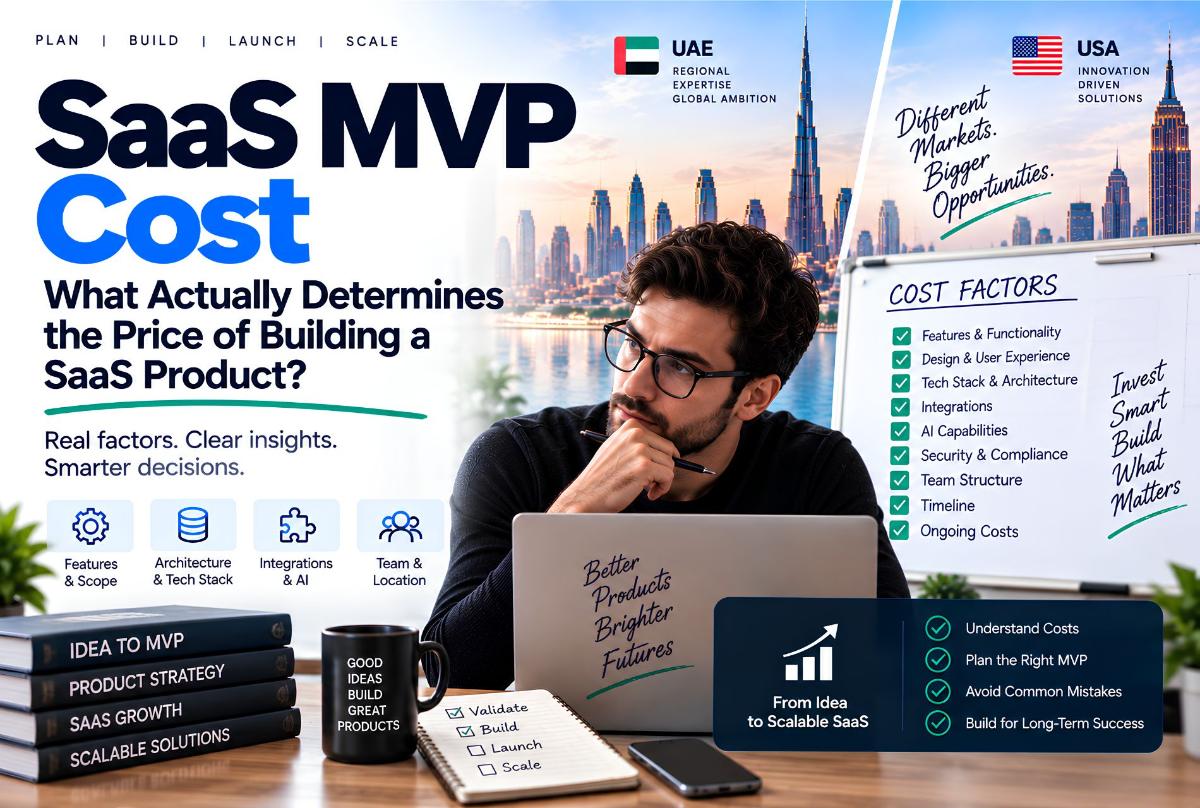
There is no useful universal price for a SaaS MVP.
A product with login, one workflow and a basic dashboard is fundamentally different from a multi-tenant SaaS platform with subscriptions, complex permissions, integrations, mobile applications and AI.
So when someone asks “How much does it cost to build a SaaS MVP?”, the more useful question is: What exactly needs to be built for the first version to prove the product?
That distinction matters because scope drives development effort — and therefore SaaS MVP cost.
This guide is for founders and operators in the United States and UAE evaluating SaaS MVP development cost, comparing MVP development services, or talking to a SaaS MVP development company. Largify’s SaaS product development service separates MVP engineering from broader capabilities such as multi-tenant architecture, billing, KPI dashboards, autoscaling infrastructure and API integrations.
Related reading: SaaS MVP development: what should you build first?, agency vs dedicated product engineering firm, and how to scope a software development project.
SaaS MVP Cost Breakdown
The cost to build a SaaS MVP is usually influenced by several interconnected areas:
| Cost driver | Lower complexity | Higher complexity |
|---|---|---|
| User authentication | Basic login | Complex roles and permissions |
| Core workflow | One workflow | Multiple interconnected workflows |
| SaaS architecture | Simple application | Multi-tenant platform |
| Billing | None or simple | Recurring, usage-based or tiered |
| Integrations | Few | Multiple external systems |
| AI | None | AI workflows or agents |
| UI/UX | Standard interface | Custom product experience |
| Mobile | None | iOS + Android |
| Admin | Basic controls | Advanced operational console |
| Security | Standard | Highly sensitive data and strict controls |
| Analytics | Basic metrics | Advanced business intelligence |
| Infrastructure | Simple deployment | Scalable cloud architecture |
This is why comparing SaaS development cost quotes without comparing scope can be misleading.
A SaaS MVP Is Not a Smaller Version of the Final Product
One of the biggest mistakes founders make is taking their entire product roadmap and calling it an MVP.
For example, you want CRM, payments, analytics, an AI assistant, a mobile app, notifications, integrations, team management, automation, reporting, a marketplace and a customer portal — then you ask a development company: “What will this MVP cost?”
That is not really an MVP specification. It is a product roadmap.
A proper MVP should isolate the smallest useful version of the product. For how to decide what belongs in that first release, see what to build first in a SaaS MVP.
What Should Be Included in the First Version?
Start with the primary customer workflow.
Suppose you are building SaaS scheduling software. The core workflow might be:
- Business creates services
- Staff availability
- Customer books
- Business manages appointment
- Customer confirmation
That workflow may be enough to validate the basic product. You may not need AI scheduling, loyalty programs, advanced analytics, native mobile applications, complex marketing automation, or multiple payment providers in version one.
Those can become later roadmap items — which is how you control MVP software development cost without pretending “cheap” equals “low quality.”
The Five Biggest Factors Affecting SaaS MVP Cost
1. Product Scope
Scope is usually the first major cost driver.
A simple application with one core workflow requires a very different amount of engineering from a platform containing multiple interconnected modules.
Consider two hypothetical products.
SaaS Product A
- Login
- Customer records
- One workflow
- Basic dashboard
- Admin panel
SaaS Product B
- Multi-tenancy
- Customer management
- Multiple user roles
- Subscription billing
- Real-time notifications
- Third-party integrations
- AI
- Advanced analytics
- Mobile application
Calling both “MVPs” does not make them equivalent projects — or equivalent SaaS product development cost.
2. Multi-Tenant Architecture
If your SaaS will serve multiple companies, architecture becomes more important.
Imagine Company A, Company B and Company C. Each customer needs access to their own users and data without exposing another customer’s information.
That introduces requirements around tenant identification, data isolation, user roles, permissions, authentication, database architecture, security and administration.
Largify’s SaaS engineering work includes multi-tenant architecture and PostgreSQL Row Level Security as part of serious custom SaaS development. This is one reason a multi-tenant SaaS application can require substantially more engineering than a simple single-business application.
3. Subscription Billing
A SaaS product often needs more than a “Pay Now” button.
Depending on the business model, billing may involve monthly or annual subscriptions, free trials, tiered plans, seat-based pricing, usage-based billing, coupons, invoices, payment failures, cancellation, plan upgrades and downgrades, and customer billing portals.
Every additional billing rule creates another workflow that needs to be designed, implemented and tested. Largify’s SaaS offering covers recurring billing, tiered pricing, seat management, usage-based metering and self-service billing when those capabilities belong in scope — not automatically on day one.
4. Integrations
Integrations can significantly change the scope of an MVP.
A founder might say “We only need a few integrations,” then list Stripe, Google Calendar, WhatsApp, Salesforce, HubSpot, Slack, email, accounting software and AI APIs.
Each integration has its own authentication, API, data model, error handling, rate limits, webhooks and testing requirements.
The important question is not “Can we integrate this?” It is: Does this integration need to exist for the MVP to validate the business? If not, move it to the next phase.
5. AI Features
AI can change development scope quickly.
There is a major difference between AI-powered text generation and an AI system connected to business data and operational workflows.
Simple AI feature
User enters a prompt. AI generates a response.
More complex AI workflow
- Customer asks a question
- AI identifies intent
- Retrieves business data
- Checks permissions
- Calls another system
- Performs an action
- Returns the result
- Logs the interaction
The second system is much more than an AI API call. It becomes part of the product architecture. When AI is genuinely part of the thesis, see Largify’s AI automation and integration services.
SaaS MVP Cost by Product Complexity
Instead of pretending there is one universal price, think in complexity bands.
Tier 1: Focused SaaS MVP
Typical characteristics: one primary user type, one major workflow, basic authentication, basic admin, simple database, limited integrations, responsive web application. This is the kind of MVP designed primarily to validate the core idea.
Tier 2: Commercial SaaS MVP
Typical characteristics: multiple user roles, multi-tenant architecture, subscription billing, customer dashboard, admin dashboard, notifications, several workflows, basic analytics, external integrations. This is closer to a product intended for paying customers from launch.
Tier 3: Complex SaaS Platform
Typical characteristics: advanced multi-tenancy, multiple business modules, complex permissions, AI workflows, multiple integrations, advanced reporting, mobile applications, complex billing, high operational requirements.
At this point, calling the product simply an “MVP” can hide the real scope. It should probably be treated as a phased product development program.
A Better Way to Think About SaaS MVP Pricing
Instead of asking “What does a SaaS MVP cost?”, break the project into:
- Product discovery
- UX and design
- Architecture
- Development
- QA
- Deployment
- Post-launch
That produces a much more useful estimate than a single line item labeled “MVP.”
Development Cost vs Total Product Cost
The initial development quote is not always the entire cost of running a SaaS product.
You may also have cloud infrastructure, database costs, email delivery, SMS or WhatsApp costs, AI API usage, payment processing fees, monitoring, domain, software subscriptions, maintenance, security updates and customer support.
These are operational costs rather than necessarily part of the initial development budget. They should still be considered before launch — especially for operators comparing UAE and US go-to-market realities. See Largify’s UAE and United States market pages.
Do Not Confuse Cheap Development With Low Product Cost
Imagine two teams quote a lower initial development cost versus a higher one. It is tempting to select the lower number immediately.
But ask: Who owns the source code? Is the architecture documented? Is the code tested? How are deployments handled? What happens after launch? Can another engineer maintain it? How difficult will future changes be? Are infrastructure accounts controlled by you? Are third-party accounts owned by you?
The cheapest initial quote can become expensive if the product needs to be rebuilt. Choosing a development partner should involve more than comparing hourly rates. See agency vs dedicated product engineering firm and the custom software development company evaluation checklist.
Why Scope Control Matters More Than Feature Count
Suppose your original MVP contains 12 features. During development, stakeholders add WhatsApp, AI, a mobile app, advanced reports, additional roles and a new payment provider. Now the product contains 18 major capabilities.
The budget and timeline cannot realistically remain unchanged. That is scope creep.
A properly scoped project should distinguish included now, planned later, and not currently required.
Largify’s software scoping approach separates objectives, users, workflows, requirements, integrations, exclusions, milestones, acceptance criteria and change management — covered in detail in how to scope a software development project.
- Add one feature
- Needs an integration
- Needs a new data structure
- Affects permissions
- Affects dashboard
- Affects mobile
A Practical SaaS MVP Scope Example
Imagine a founder wants a SaaS platform for property managers. The initial request includes properties, tenants, rent, maintenance, accounting, CRM, AI, mobile app, owner portal, tenant portal, vendor management and reporting.
A disciplined MVP might become:
Version 1
- Property — create property, add units
- Tenant — add tenant, assign tenant to unit
- Lease — create lease, track lease status
- Rent — record rent, track payment status
- Dashboard — occupancy, outstanding rent, active leases
Version 2
- Maintenance
- Owner portal
- Tenant portal
- Notifications
Version 3
- AI
- Advanced analytics
- Mobile
- Vendor workflows
Now the development team can estimate something concrete. Related delivery context: real estate property management on ValionOS.
How Much Should You Budget for a SaaS MVP?
There is no responsible single number without seeing the actual requirements.
A useful budget should be based on Scope × Complexity × Team × Delivery Model rather than “SaaS MVP = $X.”
If you receive a quote without a clear feature scope, user-flow definition and delivery assumptions, the number is difficult to evaluate.
For a serious SaaS product, ask for a breakdown covering discovery, UX/UI, backend, frontend, database, authentication, multi-tenancy, billing, integrations, QA, deployment, documentation and post-launch support. That makes proposals easier to compare across a SaaS development company USA, a SaaS development company UAE, or an internal team.
How Largify Structures SaaS MVP Development
Largify’s SaaS product development work positions MVP engineering around a production-ready first release focused on usability, the core value proposition and maintainable code. Separate capabilities cover multi-tenant architecture, billing, analytics, cloud deployment and API ecosystems.
That separation matters because not every SaaS idea needs every capability on day one. The goal should be to identify what the first release actually needs.
- Product definition
- MVP scope
- Architecture
- Development
- Testing
- Launch
- Iteration
If you are ready to turn a roadmap into a scoped first release, start a SaaS MVP discovery discussion.
Real Example: ValionOS
ValionOS is a useful example because it is a proprietary SaaS product developed by Largify rather than a simple one-off client application.
The public case study describes ValionOS as a multi-industry business operating system combining operations, automation, customer management and AI-powered workflows within a connected SaaS platform — a multi-tenant product with iterative development.
That type of product demonstrates why SaaS cost cannot be estimated from the word “MVP” alone. A platform intended to evolve across industries has different architectural considerations from a narrow application designed around one workflow.
Read the ValionOS SaaS product case study.
Another Example: Avoeline
Avoeline is another Largify proprietary SaaS product, focused on event management for universities and corporate training.
Its public case study describes an MVP to Phase 2 roadmap covering event creation, registration, check-in, certification and analytics, with web and mobile product surfaces.
The useful lesson is the separation between MVP direction and future capabilities. A product can have a larger long-term vision without forcing every planned capability into its first release.
SaaS MVP Cost in the UAE and United States
For companies in the UAE and United States, the same engineering principles apply, but commercial and operational requirements can differ.
A UAE SaaS product may need Arabic and English user journeys, WhatsApp workflows, AED pricing, local payment requirements and Gulf timezone operations.
A US SaaS product may have different requirements around billing, customer expectations, integrations, data handling, product distribution and support coverage.
The market does not determine the entire development cost. The product’s architecture and scope still matter most. Largify delivers across both markets — see all markets, UAE and USA.
10 Questions to Ask Before Accepting a SaaS MVP Quote
- What exactly is included? Get the feature and workflow scope in writing.
- What is excluded? This is just as important.
- What happens when requirements change? There should be a documented change process.
- Who owns the source code? Do not leave this vague.
- Who controls the cloud accounts? Ideally, the business should retain appropriate ownership and access.
- Is the architecture designed for SaaS? Ask how tenant data and permissions are handled.
- What happens after launch? Clarify maintenance and future development.
- How is testing handled? Critical workflows should be tested before launch.
- What is the MVP versus Phase 2? You should know exactly where the boundary sits.
- How are milestones accepted? Working software and acceptance criteria should be clearly defined.
SaaS MVP Cost Checklist
Before requesting a development quote, prepare:
Product
- Target customer
- Problem
- Core value proposition
- Primary workflow
Users
- User types
- Roles
- Permissions
Features
- Must-have
- Supporting
- Later
Technical
- Web or mobile
- Integrations
- AI requirements
- Data requirements
- Security requirements
Commercial
- Pricing model
- Subscription model
- Trial requirements
- Payment provider
Delivery
- Timeline expectations
- Milestones
- Acceptance criteria
- Source-code ownership
- Post-launch support
The more clearly these are defined, the more meaningful your development estimate becomes.
The Biggest SaaS MVP Cost Mistake
The most expensive sentence in an early SaaS project can be: “Let’s add it now because it might be useful later.”
That sentence appears harmless. Then one feature requires another. The second feature requires an integration. The integration requires a new data structure. The new data structure affects permissions. The permissions affect the dashboard. The dashboard affects the mobile application.
Suddenly, a small addition has changed the architecture. That is why MVP discipline matters: build what proves the product, architect reasonably for the future, and do not build the future before you have validated the present.
Final Takeaway
There is no single “SaaS MVP cost.” The price depends on what you are actually building.
The biggest variables are product scope, core workflows, multi-tenancy, user roles, billing, integrations, AI, mobile requirements, security, analytics, infrastructure, testing and delivery model.
If you want a meaningful estimate, start with the product rather than the budget. Define who uses it → what problem they have → what they need to accomplish → what the MVP must contain → what can wait → what architecture is required. Then request the development estimate.
That turns “How much does a SaaS MVP cost?” from a vague pricing question into an actual engineering decision.
If you are planning a SaaS product for the United States or UAE, Largify’s SaaS product development services cover MVP engineering, multi-tenant architecture, billing, analytics, cloud deployment and API integrations.
Discuss your SaaS MVP with Largify · what to build first · custom SaaS development cost · SaaS development team · development process · custom SaaS vs off-the-shelf · ValionOS · Avoeline · build your product.
Building a SaaS product in a specific market? See MVP development for US startups, SaaS development in Dubai and SaaS development in Saudi Arabia.
Frequently Asked Questions
How much does it cost to build a SaaS MVP?
There is no reliable universal figure. Cost depends on the product’s workflows, architecture, user roles, integrations, billing, AI, security, mobile requirements and other technical requirements.
What is the cheapest way to build a SaaS MVP?
The most direct way to control cost is usually to reduce scope rather than reduce engineering quality. Focus the first release on one clearly defined customer problem and its core workflow.
Does a SaaS MVP need multi-tenancy?
If the product is intended to serve multiple independent businesses or organizations, multi-tenancy should be considered during architecture planning. The specific implementation depends on the product.
Should I include AI in my SaaS MVP?
Include AI when it directly contributes to the core product value. If it is merely an additional feature, it may be better suited to a later release.
Does SaaS MVP development include billing?
It can, but billing requirements vary. A product may need simple subscriptions, tiered plans, usage-based billing, seats, trials or other models.
How long does SaaS MVP development take?
There is no useful universal timeline. Largify’s SaaS service positions a standard SaaS MVP around approximately 8 to 12 weeks depending on scope and requirements — complex multi-tenant platforms with AI, billing and multiple integrations take longer.
Should I hire a SaaS development company or individual developers?
That depends on the product’s complexity and your internal capabilities. A product requiring coordinated product design, architecture, frontend, backend, QA and deployment may benefit from a structured engineering team. For role-by-role planning, see SaaS development team structure.