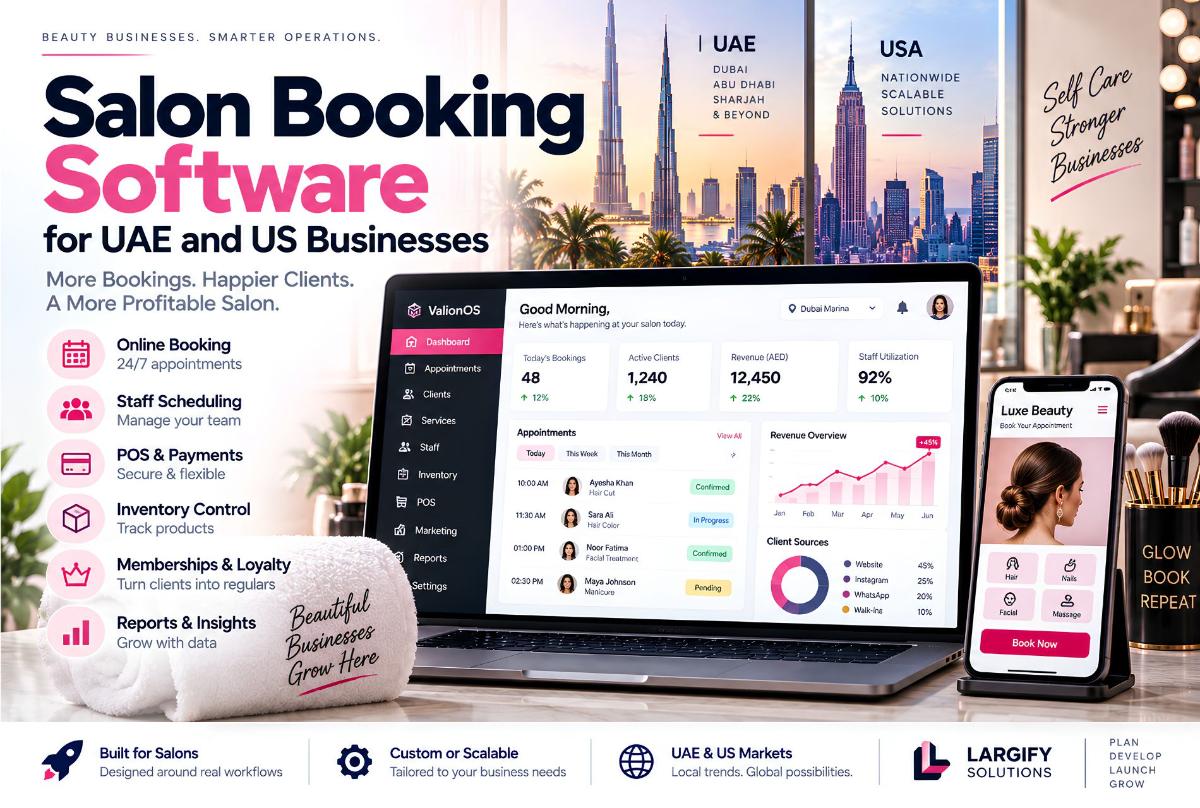
An online booking system for salons is not simply a calendar placed on a website. Serious salon booking software has to manage the relationship between customers, services, staff, time, branches, resources, payments, and customer history.
- Customer
- Service
- Staff member
- Time
- Branch
- Resources
- Payment
- Customer history
That becomes considerably more complicated when the salon has multiple employees, multiple branches, walk-ins, different service durations, rooms, equipment, memberships, and recurring customers.
For a small salon, a simple online booking tool may be enough. For a growing salon business, the booking system can become part of the company’s operational infrastructure — which is why buyers also search for salon management software, salon booking software Dubai, and salon booking software USA.
Related reading: Beauty & Wellness industry hub, multi-branch POS, inventory and bookings, and custom B2B software for UAE and US businesses.
What Is Salon Booking Software?
Salon booking software allows customers and staff to create and manage appointments digitally.
A basic system might provide online appointments, calendar management, staff schedules, customer records, and appointment reminders.
A more advanced salon management platform can connect booking with POS, inventory, CRM, memberships, loyalty, payments, staff commissions, marketing, reporting, and multi-branch operations.
That distinction matters. A booking calendar solves scheduling. A connected salon operating system manages the business around those appointments.
Why Salons Are Moving Beyond Manual Booking
A salon can technically manage appointments through phone calls, WhatsApp, Instagram messages, spreadsheets, and paper diaries. The problem appears when volume increases.
Imagine a customer asks: “Can I book a haircut tomorrow afternoon?” The receptionist has to check the stylist’s availability, service duration, whether the stylist is working that day, the branch, confirm the time, record the appointment, send confirmation, and update the calendar.
Multiply that process by dozens of enquiries. The issue is not that the receptionist cannot book appointments. The issue is that the business is using human time to perform a process software can structure.
What Should Salon Booking Software Include?
The exact feature set depends on the salon. Several capabilities are worth evaluating.
1. Online booking
Customers should be able to see available services and appointment slots without contacting reception.
- Choose service
- Choose staff member
- Choose branch
- Choose date
- Choose time
- Confirm booking
- Receive confirmation
The simpler the booking journey, the fewer unnecessary steps the customer has to complete.
2. Staff scheduling
A salon booking system should understand that not every employee is available for every service.
| Staff | Service | Availability |
|---|---|---|
| Stylist A | Haircut | Mon–Sat |
| Stylist B | Hair color | Tue–Sat |
| Therapist C | Facial | Mon–Fri |
The system should only expose appointment slots that actually work. Otherwise, the booking system creates a new problem instead of solving one.
3. Service duration
Not every appointment takes the same amount of time — for example haircut 30 minutes, hair coloring 90 minutes, facial 60 minutes, manicure 45 minutes.
The availability engine needs to account for service duration. If a 90-minute treatment starts at 2:00 PM, the system should not offer another appointment to the same staff member at 2:30 PM. This is one of the fundamental pieces of reliable salon appointment scheduling software.
4. Multiple staff members
A customer may select a haircut with preferred stylist “any available.” The system then needs to identify which staff members can perform that service and return available times — more useful than a static calendar.
5. Walk-in and online booking
Salons rarely operate entirely through online reservations. They also have walk-ins. The system needs to support both online booking and staff-created booking so the front desk can add a walk-in without conflicting with an existing online reservation.
6. Double-booking prevention
If Stylist A has a 45-minute haircut at 10:00 AM, the system should not allow another appointment requiring that same stylist during the occupied period.
The same principle can apply to rooms and equipment. A treatment may require a therapist, treatment room, and equipment — all three need to be available. Businesses comparing beauty salon booking software should examine whether scheduling accounts for those constraints, not only a simple time grid.
7. Customer profiles
A useful system should remember the customer: name, phone, email, appointment history, services used, preferred staff, membership, loyalty status, notes, and spending history. This turns booking data into customer data and creates the foundation for retention workflows.
8. Appointment history
A customer might visit every few weeks. The system can show previous appointment, service, staff member, date, and next appointment — useful for understanding repeat visits and customer behavior.
9. Automated reminders
A booking system can send reminders before appointments via email, SMS, WhatsApp, or in-app notifications, depending on the platform and integrations. The purpose is straightforward: customer books → system remembers → customer receives reminder.
In the UAE, messaging channels such as WhatsApp often sit alongside online booking in day-to-day salon communication, which is why salon software UAE evaluations frequently include messaging workflows — see also Largify’s UAE market context.
10. Rescheduling and cancellation
Customers change plans. The system should handle rescheduling, cancellation, no-show status, cancellation policies, and appointment history. Without proper status management, the calendar becomes unreliable.
11. Deposits and payments
Some salons require a deposit before confirming an appointment: select service → select time → pay deposit → appointment confirmed. Others collect payment at the salon. The booking system should support the business model rather than force one.
12. Salon POS integration
Booking and payment should not necessarily live in separate systems. A customer books a hair treatment, arrives, and the salon sells the service, a product, and an add-on. The POS records the transaction. The customer profile can then contain both appointment history and purchase history — a richer record, which is what buyers mean by a salon POS and booking system.
Largify’s Man of Cave case study is an example of website, booking, POS, and mobile app work in the beauty vertical — labeled for what was delivered, not as a generic “salon ERP” claim.
13. Inventory management
This becomes important when the salon sells products or consumes products during services — for example hair color, developer, shampoo, and treatment product. A connected system can associate product usage with services and inventory. This is where booking software begins moving toward salon management software.
14. Memberships and packages
A salon may sell a 10-session facial package or a monthly membership. The system should track package purchased, sessions used, sessions remaining, expiry, and payment status — otherwise staff verify balances manually.
15. Loyalty programs
Appointments can connect to loyalty: appointment completed → points awarded → customer reaches reward threshold → offer available. The exact model depends on the business. The important point is that loyalty data connects to actual customer activity.
Multi-Branch Salon Booking Systems
This is where salon software becomes significantly more complex. Imagine branches in Dubai Marina, Downtown Dubai, Abu Dhabi, and Sharjah — each with different employees, hours, services, inventory, revenue, and booking capacity — while management still wants one centralized system.
- Branch A
- Branch B
- Branch C
- Branch D
Each branch can keep its own operational data while management gets a consolidated view. That is one reason multi-branch salon businesses may outgrow a simple booking application. For the broader pattern, see multi-branch management systems.
What Should a Multi-Branch Salon Dashboard Show?
Management may want revenue by branch, bookings by branch, staff utilization, service performance, customer growth, inventory, no-shows, memberships, and product sales.
The purpose is not a dashboard full of numbers. It is to answer operational questions: which branch is busiest, which services generate the most bookings, which staff have unused capacity, which customers have not returned, which products need replenishment?
Salon Booking Software in the UAE
The UAE deserves its own consideration because local salon workflows can involve specific operational requirements — AED billing, VAT-aware invoicing, WhatsApp communication, multi-branch management, online booking, staff management, inventory, and customer management.
A generic booking calendar is not necessarily enough for a growing Dubai salon. The question becomes: does the software understand the entire salon workflow? Explore Largify’s UAE delivery context and the Beauty & Wellness hub for how product vs custom booking paths are framed.
Salon Booking Software for Dubai
A Dubai salon may have customers booking through website, Instagram, WhatsApp, phone, and walk-in. A useful system should bring these bookings into a common calendar: Instagram enquiry → booking page → available slot → confirmation → reminder → visit → POS → customer history.
The more of this workflow is connected, the less manual coordination the salon needs — which is the commercial intent behind salon booking software Dubai searches.
What About US Salons?
The underlying booking requirements are similar in the United States: online booking, staff calendars, customer profiles, POS, memberships, packages, inventory, marketing, and multi-location management.
The difference is primarily market context, integrations, payment environment, and business requirements. For SEO and delivery, that gives two related opportunities — UAE-focused salon booking software UAE / Dubai and US-focused salon booking software USA — while this article establishes the broad topic. See Largify’s US market page for Western delivery context.
How Much Does Salon Booking Software Cost?
There is no single correct price. A simple booking system might only require calendar, services, staff, customer records, and online booking. A more sophisticated platform may include POS, inventory, CRM, memberships, loyalty, multi-branch, payments, WhatsApp, marketing automation, and advanced reporting.
These are different software products in terms of scope. The important comparison is not simply “$X per month vs $Y per month.” It is: what business process does each system actually cover?
For scoping custom builds before estimating, read how to scope a software development project.
Off-the-Shelf Salon Software vs Custom Booking Software
Off-the-shelf software
Usually makes sense when your workflow is standard, you need to launch quickly, existing features cover requirements, you do not need extensive customization, and the software already integrates with your systems.
Custom booking software
May make sense when booking logic is unusual, you operate multiple branches, you need proprietary workflows or specific integrations, you want your own customer experience, your software will become a commercial SaaS product, or existing platforms force too many workarounds.
Custom does not automatically mean better. If an existing platform handles the workflow properly, rebuilding it makes little sense. Evaluate via custom software development or SaaS product development when the product itself is the business.
When Should a Salon Build Its Own Booking System?
Consider a growing salon with 5 branches, 50+ employees, different service rules, multiple treatment rooms, memberships, product sales, loyalty, and branch-level reporting. The business tries several booking systems. Each solves part of the problem — bookings, POS, marketing, loyalty — and employees move data between systems.
At that point the question is no longer “which booking app should we buy?” It becomes: should these workflows become one connected platform? That is where custom software development becomes worth evaluating.
Custom Salon Booking Software Architecture
A custom platform might center on an appointment engine connected to staff, branch, service, CRM, POS, inventory, memberships, and reporting.
- Staff
- Branch
- Service
- CRM / clients
- POS
- Inventory
- Memberships
- Reporting
The exact architecture should depend on the business. The important principle is that booking should not become an isolated database if the business needs booking information elsewhere.
How ValionOS Fits Into This Model
Largify’s ValionOS is positioned as a multi-industry business operating system rather than a salon-only booking application. Its broader architecture connects CRM, bookings, finance, inventory, HR, projects, reporting, and automation.
The ValionOS case study describes a multi-tenant AI business operating system designed around modular business applications and shared business data.
That makes it relevant to the larger problem: a salon does not only need a calendar. It may eventually need an operating system around the calendar. For straightforward requirements, dedicated booking software may be sufficient. For interconnected operations, a broader platform architecture can make more sense.
A Practical Salon Booking MVP
If a salon wants custom software, do not build everything immediately.
Phase 1
- Customer management, services, staff, availability
- Online booking, calendar, appointment reminders
- Basic dashboard
Phase 2
- POS, inventory, memberships, packages
- Loyalty and customer segmentation
Phase 3
- Multi-branch and advanced reporting
- Marketing automation and WhatsApp workflows
- AI receptionist and advanced business intelligence — only after the core booking workflow is proven
Common Salon Booking Software Mistakes
- Building a calendar instead of a booking engine — a calendar shows appointments; a booking engine understands availability.
- Ignoring resources — a treatment may require staff, room, and equipment simultaneously.
- Forgetting walk-ins — real salons often have both online bookings and walk-ins.
- No customer history — forgetting previous interactions loses operational context.
- No branch architecture — adding branches later is hard if the database was designed for one location.
- Building too much too early — you do not need AI, loyalty, and advanced analytics before proving core booking works.
What Should You Ask Before Choosing Salon Booking Software?
- Booking — online booking, staff-created bookings, rescheduling, double-booking prevention?
- Staff — availability by employee, service restrictions, schedule management?
- Resources — rooms and equipment affecting availability?
- Customer — appointment history, notes, preferences?
- Business — POS, inventory, memberships, loyalty?
- Multi-branch — one account, restricted branch managers, consolidated reporting?
- Integration — API, existing systems, data export?
These questions reveal whether the product is genuinely suitable for the salon or simply has a booking calendar.
The Bigger Opportunity: From Booking Software to Salon Operating System
Booking is often the entry point. The actual business workflow can be much larger:
- Marketing
- Lead
- Booking
- Appointment
- Service
- Payment
- Product sale
- Customer profile
- Loyalty
- Rebooking
- Marketing follow-up
A disconnected system treats these as separate events. A connected platform treats them as one customer lifecycle. That is the direction modern salon software can take — whether via a dedicated salon product path, custom software, or a broader operating system such as ValionOS.
Final Takeaway
The right salon booking software depends on the complexity of the business.
A small salon may only need services + staff + calendar + online booking. A multi-branch salon may need booking + CRM + POS + inventory + memberships + loyalty + reporting + automation. A company building a salon technology product may need a scalable multi-tenant SaaS platform.
The important decision is not which booking software has the most features. It is: which system matches the way the business actually operates?
For UAE businesses, that can include multi-branch operations, AED workflows, WhatsApp communication, and local business requirements. For US businesses, the architecture may need different integrations, payment workflows, and operational models.
For companies that have outgrown standalone booking software, the next step may be a connected salon management platform or custom business operating system.
Frequently Asked Questions
What is the best booking system for a salon?
The appropriate system depends on the salon’s size, number of staff, branches, services, payment requirements, and integrations. A small salon may need only online booking and scheduling, while a multi-branch business may need POS, CRM, inventory, and reporting.
What should salon booking software include?
Core features generally include online booking, service management, staff availability, calendars, customer profiles, reminders, rescheduling, and cancellation management. More advanced systems can include POS, inventory, memberships, loyalty, and multi-branch management.
Can salon booking software integrate with POS?
Yes. A booking platform can be integrated with POS so appointment and transaction information can be connected.
Can one booking system manage multiple salon branches?
Yes. Multi-branch systems can centralize management while keeping staff, appointments, inventory, and reporting organized by location.
Should a salon build custom booking software?
Only when existing software cannot adequately support important workflows or when the business itself is building a software product. Standard requirements are often better handled by existing platforms.
How much does custom salon booking software cost?
The cost depends on features, number of users, integrations, branches, platforms, automation requirements, and development scope. A proper requirements and workflow assessment should happen before giving a serious estimate.
Need a Custom Booking or Salon Management Platform?
Largify can help evaluate whether your business needs an existing booking platform, customized software, or a broader operational system. The process starts with the workflow rather than the feature list.
Explore custom software development · SaaS product development · Beauty & Wellness · Man of Cave case study · ValionOS case study · custom booking software cost guide.
Discuss a custom booking or salon management system with Largify.