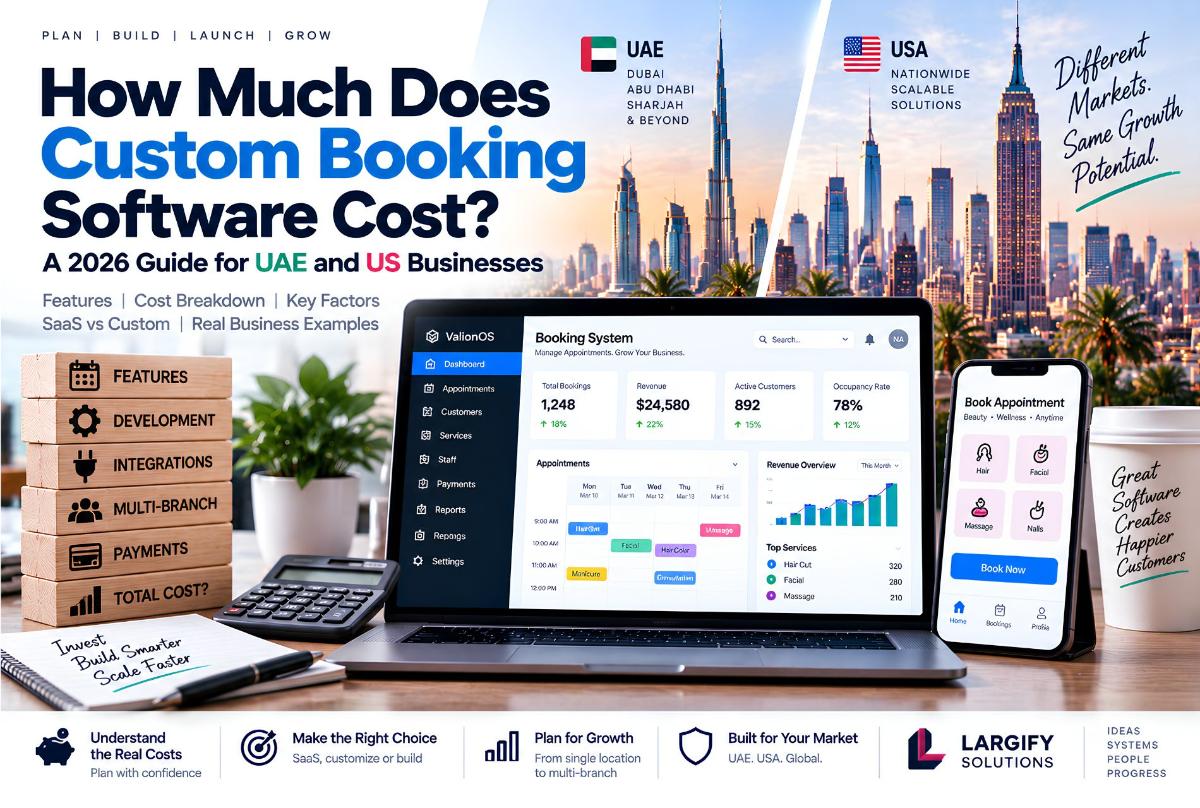
Custom booking software cost can vary dramatically depending on what the business actually needs.
A basic booking application might only require services, staff availability, a calendar, customer accounts, online booking, and notifications.
A business operating platform may need multi-branch scheduling, POS, payments, inventory, customer management, memberships, loyalty, WhatsApp, reporting, mobile applications, integrations, role-based permissions, and automation.
Those are not the same project. Asking “How much does booking software cost?” without defining the workflow is like asking how much a building costs without specifying whether you need a shop, apartment, or warehouse. The software scope determines the cost.
This guide is for commercial investigation across the UAE (primary) and United States (secondary). For what salon booking software should include, see online booking system for salons. For buy-vs-build software decisions more broadly, see custom B2B software for UAE and US businesses.
Largify Solutions Quote Starting Point
For custom booking and related operational software, Largify Solutions quotes typically start from around AED 3,000 on average, and the final estimate depends on the software requirements — users, workflows, branches, payments, integrations, platforms, and MVP scope.
That starting figure is a planning entry point for discovery, not a fixed package price. A focused booking MVP and a multi-branch salon operating platform are different projects. The accurate way to price work is to map requirements first — which is why Largify follows software project scoping before locking a serious estimate. Request a scoped quote.
Custom Booking Software Cost in the UAE
The UAE market currently contains a wide range of booking and salon-management products. Published UAE salon software subscription examples currently range from relatively low monthly plans for small staff teams to several hundred dirhams per month for broader platforms; some enterprise products do not publish prices and require a quotation. Those figures are third-party published examples, not Largify pricing and not a universal market benchmark.
That creates three broad choices:
| Approach | Typical model | Suitable for |
|---|---|---|
| Existing booking SaaS | Monthly subscription | Standard booking |
| Configured business software | Subscription + modules | Growing operations |
| Custom development | Project investment | Proprietary workflows |
The important comparison is not simply the monthly price. It is what the system actually replaces or connects. For Dubai and UAE delivery context, see Largify’s UAE market page and Beauty Salon product.
Custom Booking Software Cost in the United States
The US market follows the same fundamental principle. Businesses can choose appointment SaaS, industry-specific booking platforms, scheduling tools, custom web applications, or custom SaaS platforms.
External development estimates vary significantly. One 2026 third-party development guide places focused custom booking systems in a lower planning band and more operational scheduling systems in a higher band, depending on resources, payments, integrations, and workflow complexity. Those are one provider’s planning ranges — not an industry-wide price benchmark and not Largify pricing.
That distinction matters because a “booking system” can describe anything from a simple calendar to a multi-tenant platform. US delivery context: United States market page.
What Actually Determines Booking Software Development Cost?
The biggest mistake is counting screens. A system with 15 screens can be more complicated than one with 40 screens.
The real cost drivers for booking software development cost are usually:
- Booking logic
- User roles
- Availability rules
- Resources
- Payments
- Integrations
- Multi-location architecture
- Mobile requirements
- Reporting
- Automation
- Security
- Data migration
1. Booking Logic
A simple booking workflow might be:
- Choose service
- Choose date
- Choose time
- Confirm
A more complicated system might need:
- Choose service
- Choose branch
- Choose employee
- Check availability
- Check room & equipment
- Calculate duration & price
- Apply membership
- Collect deposit
- Confirm
Every additional rule increases business logic. The booking interface is rarely the difficult part. The difficult part is making sure the system understands when a booking is actually possible.
2. Staff Scheduling
Consider a salon with 20 employees, different working hours, different services, leave schedules, breaks, and branch assignments. A customer wants hair coloring with an available colorist.
The system needs to determine which staff can perform the service, who is working, who is available, how long the service takes, and whether there is enough time before the next appointment. That requires scheduling logic — not just a calendar. See also salon booking software features.
3. Multiple Resources
Some appointments require more than one resource — for example a facial may need a therapist, treatment room, and equipment. All three need to be available. A booking system that checks only the employee can still create a conflict. Resource-based scheduling adds another layer of complexity to appointment booking software cost.
4. Multiple Branches
A single-location booking system is fundamentally different from multi-branch booking software. Imagine Dubai Marina, Downtown Dubai, Abu Dhabi, and Sharjah — each with different employees, services, opening hours, prices, inventory, managers, and capacity — while management still wants one dashboard.
That requires architecture capable of separating branch-level data while providing centralized management. Largify’s Beauty Salon product is structured around bookings, staff, payments, loyalty, memberships, and related salon operations rather than treating booking as an isolated calendar. For the broader pattern, read multi-branch management systems.
5. Payments and Deposits
Payment integration can change the project substantially. A booking system might support full payment, partial deposit, pay later, refunds, cancellation fees, failed payments, payment status, and invoices.
A simple booking page does not need all of these. A commercial booking platform often does. The payment provider also introduces external API and webhook requirements.
6. WhatsApp and Messaging
In the UAE especially, WhatsApp can be an important part of customer communication. A booking system might send booking confirmation, reminders, rescheduling notifications, and review requests.
“WhatsApp integration” should not be treated as one simple feature. It can involve templates, message triggers, customer replies, message status, conversation history, provider APIs, and usage fees — all of which affect custom booking system UAE estimates.
7. Customer Management
A booking system becomes more useful when it remembers the customer: contact information, booking history, preferred staff, services, membership, packages, notes, loyalty points, and purchase history. Now the software is doing more than scheduling. It is becoming a customer management system.
8. POS Integration
Consider a salon appointment flow:
- Customer books
- Customer arrives
- Service completed
- Product purchase
- Payment
- Receipt
- Customer history updated
If booking and POS are separate systems, information may need to be transferred. If they are connected, the booking becomes part of the transaction workflow. This is one area where custom development can become more valuable than a standalone booking calendar — as illustrated by delivery work such as Man of Cave (website, booking, POS).
9. Inventory
Inventory adds another layer. A salon might consume products during appointments and sell products directly. The system can potentially connect appointment → service → product usage → inventory → sale. This is no longer simply appointment scheduling. It is operational software.
10. Memberships and Packages
A customer may purchase 10 facial sessions. The booking system needs to know sessions purchased, used, remaining, expiry, and applicable services. Without this logic, employees may have to manually check package balances — which increases salon booking software cost when built into a connected platform.
11. Loyalty
Loyalty programs can connect to bookings: completed appointment → points awarded → customer reaches threshold → reward becomes available. This requires customer-level business rules rather than basic scheduling.
12. Admin Dashboards and Reporting
Management may need total bookings, revenue, bookings by branch, revenue by service, staff utilization, no-shows, customer retention, and membership usage. The dashboard is not necessarily the expensive part. Complexity comes from collecting, validating, and connecting the underlying data.
13. Mobile Applications
A web booking system and a full mobile application are different projects. You might need a customer app, staff app, and manager app — each with different permissions and workflows. If mobile applications are required, project scope expands significantly. See mobile app development.
14. Integrations
Integrations are one of the most underestimated parts of custom software. A project might need a payment gateway, WhatsApp, SMS, email, accounting, CRM, Google Calendar, maps, POS, inventory, or an existing ERP.
Each integration needs its own requirements. “Integrate WhatsApp” and “send booking confirmation through WhatsApp” are not necessarily the same project.
Three Ways to Build a Booking System
Option 1: Buy existing booking software
You subscribe to an existing product. This is usually appropriate when your workflow is standard, you want fast deployment, you do not need proprietary functionality, and existing integrations are sufficient.
Published UAE salon SaaS plans can begin at relatively low monthly subscription levels for small teams. That makes buying software worth evaluating before commissioning a custom system — especially for standard online booking software cost comparisons.
Option 2: Configure existing software
Sometimes the business needs more than the basic plan but does not need a completely new application. You might combine a booking platform, website, payment system, CRM, automation, and reporting. This can work well if the tools integrate cleanly. The problem starts when employees spend more time moving data between systems than using them.
Option 3: Build custom booking software
Custom development becomes more relevant when your workflow is unusual, multiple systems must connect, you operate many locations, you need proprietary business rules, existing software creates operational workarounds, the booking system itself is your product, or you need ownership and control of the platform.
Largify’s custom software development path is for situations where off-the-shelf products do not adequately fit the required workflow. Quotes for custom booking work typically start from around AED 3,000 and scale with requirements.
A Practical Cost Model
Instead of asking “What does a booking system cost?”, break the project into layers:
- Layer 1: Core booking
- Layer 2: Business operations
- Layer 3: Growth
- Layer 4: Scale
- Layer 5: SaaS platform
- Layer 1: Core booking — services, availability, calendar, customer booking, staff scheduling
- Layer 2: Business operations — customers, payments, POS, inventory, memberships, packages
- Layer 3: Growth — loyalty, marketing, WhatsApp, reviews, rebooking, segmentation
- Layer 4: Scale — multiple branches, advanced permissions, mobile apps, advanced reporting, integrations, automation
- Layer 5: Platform — multi-tenancy, subscription billing, tenant administration, product analytics, scalable infrastructure, API ecosystem
The further down the stack the project goes, the more it moves from booking software toward a business platform or SaaS product — closer to SaaS product development.
Example: Three Different Booking Projects
Example A: Small salon
Requirements: online booking, services, staff, calendar, customer profiles, email reminders. There is probably little reason to build a completely custom platform if existing software already handles these requirements.
Example B: Multi-branch salon
Requirements: five locations, different staff, branch managers, online booking, walk-ins, POS, inventory, memberships, loyalty, WhatsApp, central reporting. This is significantly more complex. At this point, compare a mature salon-management platform against a custom solution — and expect a quote well above a basic AED 3,000 starting point once operations modules are included.
Example C: SaaS booking product
If the company wants to sell the booking software to thousands of businesses, requirements change again: multi-tenancy, tenant isolation, subscription billing, onboarding, admin console, usage analytics, plan limits, self-service billing, API access, and scalable infrastructure. This is no longer simply a booking system. It is a SaaS product — see SaaS product development.
UAE vs United States: Does Location Change Development Cost?
Yes, but not simply because the software itself is different. The underlying booking logic can be similar. The surrounding business requirements can differ.
UAE projects may involve
- AED pricing
- UAE-specific business workflows
- VAT-related invoice requirements
- Arabic and English interfaces
- WhatsApp communication
- Multi-branch operations
- GCC expansion
US projects may involve
- USD transactions
- US-based payment providers
- Different accounting integrations
- Multi-state operations
- Different customer workflows
- US-specific SaaS requirements
- Enterprise integrations
See USA. Country should influence requirements, not just the keyword in the page title — which is why booking software Dubai and custom booking software USA searches often need different commercial landing pages later.
Why Custom Booking Software Can Become Expensive
The booking page is usually not what drives the cost. The expensive part is everything behind it.
“Let customers book online” sounds simple. Add stylist selection, qualification rules, working hours, treatment rooms, memberships, deposits, WhatsApp confirmation, branch manager visibility, and rescheduling — and you have gone from a booking form to an operational scheduling engine.
That is why serious estimates need workflows rather than a single feature title.
The Hidden Cost: Scope Creep
A project can begin as a booking system, then become booking + CRM, then add POS, inventory, loyalty, and marketing. Eventually nobody is building a booking system anymore. They are building an ERP-style business platform.
This is exactly why the project should be scoped before development. Read how to scope a software development project for users, workflows, MVP definition, exclusions, integrations, and change management. Related: Custom ERP vs SaaS cost.
How to Reduce Custom Booking Software Cost
The answer is not necessarily finding a cheaper developer. Reduce unnecessary scope.
- Start with the core workflow — Customer → Booking → Appointment → Completion
- Delay secondary features — loyalty, AI, advanced analytics, mobile apps, and complex marketing automation may wait for later phases
- Reuse existing services — do not rebuild infrastructure that established providers already deliver reliably
- Define integrations early — a payment integration discovered halfway through can disrupt architecture
- Separate MVP from platform — if you are building SaaS, decide what the first release must prove
When Custom Booking Software Does Not Make Sense
You should not build custom booking software simply because you can. If you operate one salon with five employees, standard services, standard appointment durations, one location, and no unusual integrations, an existing booking platform may already solve the problem.
Existing UAE products offer online booking and salon-management capabilities at subscription prices that can be much lower than commissioning a new application for standard needs.
When Custom Booking Software Makes Sense
Consider custom development when booking is connected to a larger operational problem: booking + POS + inventory + CRM + membership + multi-branch + reporting + automation.
If existing products handle each part separately but the business needs them to behave as one system, custom development deserves serious consideration. The same distinction appears in when to replace spreadsheets with custom software.
What ValionOS Shows About Connected Business Software
ValionOS is relevant because it approaches business software from a broader perspective. Rather than treating booking as an isolated feature, ValionOS is designed as a multi-industry business operating system connecting operations, customer management, automation, and AI-powered workflows.
You might begin with booking but eventually need booking → CRM → POS → inventory → finance → reporting → automation. At that point, the business is no longer asking for a calendar. It is asking for an operating system. Read the ValionOS case study.
How Largify Approaches a Custom Booking Project
The starting point should not be “How many pages do you want?” It should be business requirements, users, workflows, availability rules, integrations, MVP, architecture, testing, and launch.
Largify’s delivery model is Discovery → Build → Launch, with discovery used to determine product fit, constraints, and first-sprint outcomes before development expands. For custom booking work, quotes typically start from around AED 3,000 and depend on the mapped requirements.
Explore custom software development · request a discovery quote.
A Simple Decision Framework
| Requirement | Existing SaaS | Custom |
|---|---|---|
| Basic online booking | Yes | |
| Standard staff calendar | Yes | |
| Simple reminders | Yes | |
| Standard customer profiles | Yes | |
| Unusual booking rules | Yes | |
| Proprietary workflow | Yes | |
| Complex resource scheduling | Yes | |
| Deep integrations | Yes | |
| Multi-branch operational platform | Maybe | Yes |
| Booking is the company’s SaaS product | Yes | |
| Existing tools create major data duplication | Maybe | Yes |
This is not a rule that custom software is always the answer. It is a way to identify when operational complexity justifies investigating it.
Frequently Asked Questions
How much does custom booking software cost?
There is no universal price. A simple custom booking workflow can be substantially smaller than a multi-branch platform with payments, POS, inventory, WhatsApp, mobile apps, and integrations. Largify Solutions quotes for custom booking and related software typically start from around AED 3,000 on average and depend on requirements. Third-party 2026 development guides also publish wide planning ranges — those are provider-specific, not universal market prices.
How much does booking software cost in the UAE?
Existing UAE salon and booking products range from relatively low monthly subscriptions to more expensive multi-module or enterprise arrangements. Custom development is a project investment rather than a subscription — starting quotes at Largify typically begin around AED 3,000 depending on scope.
Is custom booking software better than SaaS?
Not automatically. If an existing SaaS product handles the required workflow, buying it may be more practical. Custom development becomes more relevant when the business has proprietary processes, complex integrations, or requirements that existing products cannot handle cleanly.
How much does a multi-branch booking system cost?
It depends on the number of branches, users, scheduling rules, permissions, integrations, reporting requirements, and whether POS, inventory, and customer management are included. Multi-branch architecture should be scoped before estimating the project.
Can custom booking software integrate with WhatsApp?
Yes, provided the required WhatsApp APIs, message workflows, and business requirements are properly defined. The integration can range from simple notifications to two-way customer conversations and automated workflows.
Should a salon build its own booking software?
A salon with standard requirements may not need to. Existing products already provide online booking and salon-management capabilities. Custom development becomes more relevant for complex workflows, multiple branches, proprietary processes, or deep connection with other operational systems. Start with what salon booking software should include.
What is the difference between booking software and a booking SaaS product?
Booking software can be built for one business. A SaaS booking product is designed for multiple independent customers and therefore requires multi-tenancy, account management, subscription billing, tenant isolation, and scalable infrastructure.
Final Takeaway
The cost of custom booking software is determined less by the booking page and more by everything that happens around the booking.
A basic system may need services + staff + calendar + booking. A growing business may need booking + CRM + payments + POS + inventory + memberships + reporting. A software company selling booking technology may need multi-tenancy + billing + APIs + analytics + scalable infrastructure.
Those are three very different projects.
For UAE businesses, local requirements such as AED workflows, WhatsApp communication, multi-branch operations, and regional business processes may affect the scope. For US businesses, payment, accounting, enterprise integration, and product requirements may lead to a different architecture.
The sensible approach is to buy existing software when it already solves the problem, configure existing systems when they can be connected cleanly, and build custom software when the workflow itself has become a competitive or operational requirement.
Build Only What Your Business Actually Needs
If you are evaluating a booking platform for a salon, clinic, rental company, service business, or multi-location operation, start by mapping the workflow before discussing development cost.
Largify builds custom software for businesses that need purpose-built workflows rather than another disconnected tool. Custom booking quotes typically start from around AED 3,000 and depend on the software requirements.
Explore custom software development · SaaS product development · salon booking features guide · ValionOS case study.