Medical ERP | Vet Medical Version
Project for
VetOs
The Challenge
Executive Summary
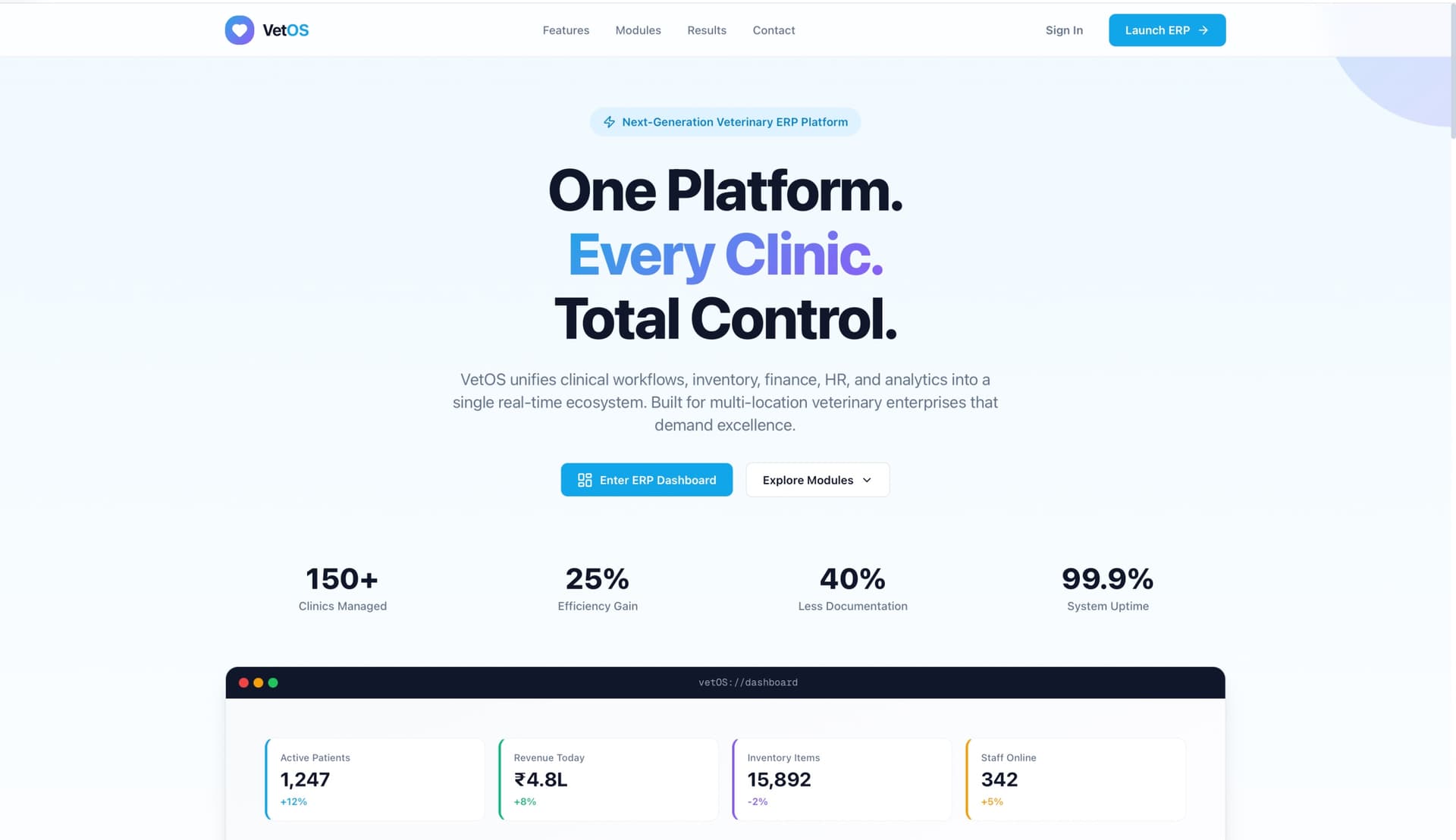
VetGlobal Enterprise is a multinational veterinary corporation operating 150 general practices, 15 specialty referral hospitals, and a pharmaceutical supply division across North America and Europe. Faced with fragmented legacy systems, inefficient inventory management, and growing administrative burdens, the leadership team recognized the need for a unified, intelligent, and scalable ERP platform. Rather than adapting off-the-shelf solutions, VetGlobal chose to build a custom system using Next.js and Firebase—a modern, serverless technology stack that promised rapid development, real-time capabilities, and effortless scaling.
The resulting platform, named VetOS, integrates every facet of the business—from clinical workflows to corporate finance—into a single, real-time ecosystem. Within 18 months of rollout, VetGlobal achieved a 25% increase in operational efficiency, a 30% reduction in inventory holding costs, and a 40% decrease in documentation time for veterinarians. This case study details the challenges, the solution architecture, the advanced features of each module, and the transformative results delivered by this purpose-built ERP.
The Challenge:
VetGlobal’s growth had outpaced its legacy infrastructure. The organization faced a common set of challenges among large veterinary groups:
Data Silos: Each clinic used a different practice management system (PMS), making it impossible to get a consolidated view of operations, finances, or patient outcomes.
Inventory Waste: Pharmaceuticals and supplies were managed locally, leading to overstocking, expiries, and frequent emergency orders. No enterprise-wide visibility existed.
Administrative Overload: Veterinarians spent up to 30% of their time on manual data entry, documentation, and billing, reducing time with patients.
Inefficient Reporting: Financial consolidation across 165 locations required days of manual work, and business intelligence was limited to static, outdated reports.
Scalability Concerns: Legacy systems could not support the company’s aggressive acquisition strategy or the demand for mobile and client-facing applications.
The IT team evaluated several commercial ERP solutions but found them either too rigid, prohibitively expensive, or lacking deep integration with veterinary-specific workflows. The decision was made to build a custom ERP that would be truly fit for purpose, leveraging modern cloud technologies to ensure agility, real-time data, and low total cost of ownership.
Our Solution
The Solution: VetOS on Next.js and Firebase
VetOS was architected as a serverless, real-time platform using two core technologies:
Next.js (React Framework): Provides the frontend with server-side rendering (SSR) and static site generation (SSG) for optimal performance and SEO. Next.js also powers the backend via API Routes, handling lightweight serverless functions and acting as a BFF (Backend for Frontend) for external integrations.
Firebase (Google Cloud): Serves as the fully managed backend, including:
Cloud Firestore: A flexible, scalable NoSQL database with real-time listeners and offline support.
Firebase Authentication: Secure user management with multi-factor authentication and role-based access control (RBAC).
Cloud Functions: Serverless functions for executing complex business logic (e.g., inventory forecasting, invoice generation) in response to database events.
Firebase Storage: For storing medical images, documents, and client uploads.
Firebase Hosting: Fast, secure hosting for the Next.js application.
Firebase Extensions: Pre-packaged solutions for tasks like sending emails or resizing images.
Why this stack?
Real-time synchronization: Firestore’s real-time listeners enable instant updates across all clinics—a critical requirement for inventory tracking, appointment scheduling, and clinical data sharing.
Scalability without ops: Serverless infrastructure automatically scales from a single clinic to thousands, with zero maintenance overhead.
Offline capability: Firestore’s offline persistence allows clinics to continue working during internet outages; data syncs automatically when connectivity is restored.
Rapid feature development: The integrated Firebase ecosystem (Auth, Functions, Storage) and Next.js’s hybrid rendering accelerate development cycles.
Cost-effectiveness: Pay-as-you-go pricing aligns with VetGlobal’s growth, avoiding large upfront investments.
Results & Impact
Results & Key Benefits
Within 3 months of full deployment, VetGlobal realized significant quantitative and qualitative improvements:
| Metric | Before | After | Improvement |
|---|---|---|---|
| Inventory Holding Costs | $4.2M | $2.9M | 30% reduction |
| Inventory Expiry Waste | 8% of stock | 2% of stock | 75% reduction |
| Vet Documentation Time | 90 min/day | 54 min/day | 40% reduction |
| Finance Consolidation Time | 5 days | 30 minutes | ~99% faster |
| Client No-Show Rate | 12% | 8% | 33% reduction |
| IT Infrastructure Costs | $1.8M/year | $0.9M/year | 50% reduction |
Additional benefits:
Real-time visibility: Corporate leaders can now monitor any clinic’s performance live.
Scalability: Onboarding a new clinic takes days instead of weeks; the system automatically scales.
User satisfaction: 92% of veterinarians reported that VetOS reduced their administrative burden, allowing more focus on patient care.
Innovation enablement: The Next.js/Firebase stack allows the internal team to experiment and deploy new features weekly.
7. Conclusion
By building a custom ERP on Next.js and Firebase, VetGlobal Enterprise not only solved its immediate operational challenges but also created a platform for continuous innovation. The serverless, real-time architecture proved ideal for the dynamic, multi-location nature of modern veterinary practice. The case demonstrates that with the right technology choices, even highly specialized industries can achieve the agility and intelligence typically reserved for tech-native companies.
VetGlobal now plans to extend VetOS with telemedicine capabilities (using WebRTC and Firebase) and integrate wearable device data from pets, further cementing its position as a leader in data-driven veterinary care.
Dr. Sarah Chen
Chief Medical Officer, VetGlobal Enterprise
Technologies Used
Project Overview
Industry
Health Care
Duration
3 Months
Team Size
4+ professionals
More Success Stories
Check out our other case studies to see how we help businesses transform
View All Case Studies